
Cannabis businesses sit on mountains of data they rarely use well. Inventory counts, cultivation logs, compliance filings, point-of-sale transactions - it all piles up daily across cultivation, manufacturing, distribution, and retail operations. The problem was never collection. The problem has always been speed: getting an answer before the moment to act on it has passed.
For most operators, that still means someone pulling reports, exporting spreadsheets, and stitching together numbers from three or four disconnected systems. By the time a manager spots a slow-moving SKU or a compliance exception, the margin hit has usually already happened. That lag is quietly expensive, and in a market where wholesale pricing keeps compressing, expensive lag is not something operators can absorb forever.
Why Compliance-First Software Falls Short on Business Insight
Cannabis software has spent most of its existence focused on one job: staying compliant with seed-to-sale tracking requirements, feeding data to state traceability systems, and generating the paperwork regulators demand. That function remains non-negotiable - nobody is arguing otherwise. But compliance reporting was never built to answer the questions operators actually lose sleep over, questions like which strains carry the best margin, or where inventory is quietly aging toward expiration.
"Most cannabis businesses already have the data they need. The challenge isn't collecting more information, it's getting answers quickly enough to take action. AI gives operators a faster way to identify risks, uncover opportunities, and make better decisions using the data they're already capturing every day," says Ben Marchi-Young.
That distinction matters. Compliance software proves a business followed the rules. It does not, on its own, tell an operator how to run the business better. Closing that gap is where artificial intelligence is starting to get traction.
Asking Questions Instead of Building Reports
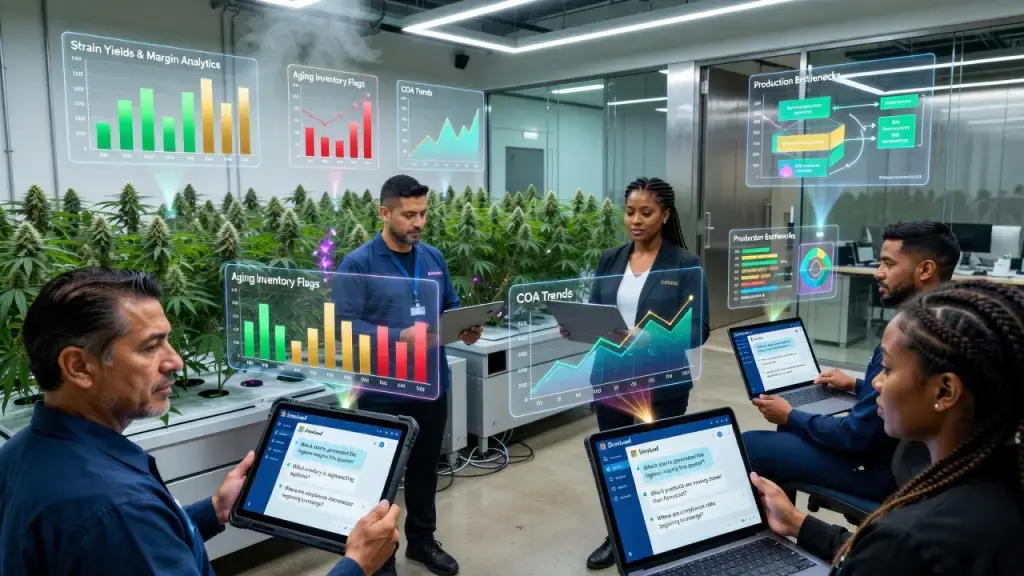
The practical shift is conversational. Instead of navigating a dozen screens to build a custom report, a manager can simply ask a system a plain-language question and get an answer pulled directly from the ERP. No SQL, no exports, no waiting on an analyst.
- Which strains generated the highest margins this quarter?
- What inventory is approaching expiration?
- Which products are moving slower than forecast?
- Where are compliance risks beginning to emerge?
- Which strains are producing the highest yields?
That sounds simple on paper. In practice, it changes who gets to make decisions. A budroom manager or inventory lead no longer has to escalate every question up the chain to someone who knows how to run a report - they can get the answer themselves, in the moment that actually matters.
Where the Risk Actually Lives: Inventory and Production
Inventory accuracy is not optional in this industry; it's tied directly to regulatory standing. Discrepancies between physical counts and tracked inventory can trigger compliance exceptions, and aging product that sits too long represents dead capital under 280E, where cannabis businesses already face a heavier federal tax burden than most retail sectors. AI tools built on operational data can flag aging inventory, discrepancies, and potential stock shortages before they surface in a periodic audit - shifting teams from reactive cleanup to proactive monitoring.
The same logic applies upstream. Across cultivation and manufacturing, AI can surface production bottlenecks, yield variances, COA trends, and fulfillment risks earlier than a manual review cycle would catch them. That earlier signal is the whole point - less time hunting for the problem, more time actually fixing it.
From Answering Questions to Acting on Them
SilverLeaf's current approach, an AI chatbot built on Microsoft Copilot, reflects where the industry is right now: exposing every table and field in the ERP through secure APIs so staff can query data in natural language from any Copilot-enabled device, across cultivation, inventory, sales, finance, and compliance alike.
What comes next is more ambitious. Concepts in development include a master variant and item creation agent to speed product setup, an inventory reservation agent that can suggest lot or tag allocation for outgoing orders - and reallocate tracked inventory when shipping priorities shift - and crop yield prediction tools that use cultivation history and in-progress data to forecast harvest outcomes before they happen.
None of this replaces compliance obligations, lab testing, or the judgment of experienced growers and compliance staff. What it does is shorten the distance between a data point and a decision. In a market where margins keep tightening and regulatory scrutiny isn't going away, that shorter distance may be the difference between catching a problem and absorbing its cost.