Federal cannabis policy is moving, but not nearly fast enough or clearly enough for operators who want certainty before they commit capital. Morgan Fox, political director of NORML, is telling cannabis businesses to stop building financial plans around assumptions about where rescheduling is headed. His reasoning is blunt: much of what operators expect from a Schedule 3 shift simply isn't coming, at least not yet, and maybe not in the form people imagine.
Schedule 3 Isn't the Relief Many Operators Think It Is
The federal government reclassified qualifying state-licensed medical marijuana and FDA-approved marijuana products to Schedule 3 in April. Adult-use cannabis did not move. It's still Schedule 1. A separate DEA proceeding will decide whether marijuana gets rescheduled more broadly, and that process could drag on, with court challenges likely waiting on the other side regardless of outcome.
That distinction matters enormously for day-to-day operations. Section 280E relief, for instance, only applies to qualifying medical marijuana businesses - adult-use operators remain stuck with the same restrictive tax treatment, unable to deduct standard business expenses the way any other company would. The IRS hasn't finished working out guidance on how the new rules even apply. Banking access may loosen somewhat as more institutions grow comfortable with qualifying medical operators, but Fox is clear that it won't be enough to bank the industry at large. And rescheduling does nothing to resolve the core conflict between state legalization and federal prohibition for adult-use markets.
There's also a compliance wrinkle operators can't ignore: federal registration. Qualifying medical marijuana businesses now have to meet DEA requirements around security, recordkeeping and inventory controls - state licensure alone doesn't automatically confer that status. The DEA moved forward in late October with initial registrations for more than 900 qualifying dispensaries, a meaningful step, but one that also raises a quieter risk. Sharing detailed operational data with federal regulators carries exposure if a legal challenge to the rescheduling framework ultimately succeeds. Businesses could end up with none of the anticipated benefits and a federal agency holding all the information it needs to act against them.
States with combined medical and adult-use markets, like Washington and Missouri, face an added layer of uncertainty since the DEA has offered little direction on how to separate the two programs operationally.
Hemp Beverages Draw the Alcohol Industry's Attention
While marijuana operators parse what Schedule 3 does and doesn't deliver, a different cannabinoid category is pulling in one of the most established distribution networks in American retail: alcohol. Executives from Wine & Spirits Wholesalers of America and Total Wine & More say the push into intoxicating hemp beverages wasn't driven by industry appetite - it was driven by customers walking into stores asking for THC drinks.
Retailers and distributors alike point to the three-tier system, the regulatory structure built after alcohol prohibition ended, as a ready-made framework for overseeing these products rather than banning them outright. The pitch: batch traceability for recalls, tier separation to prevent market concentration, state-level compliance oversight, and a licensing and excise tax structure through the Alcohol and Tobacco Tax and Trade Bureau that could crowd out illicit sales. Testing remains the gap - buyers evaluating hemp beverage suppliers need consistent chemistry and manufacturing standards, and that's far easier in states that have already built testing requirements into their rules.
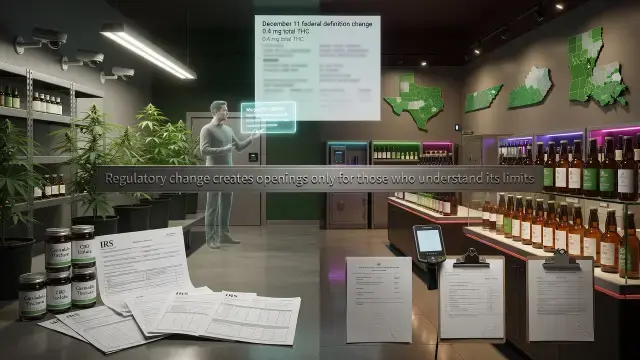
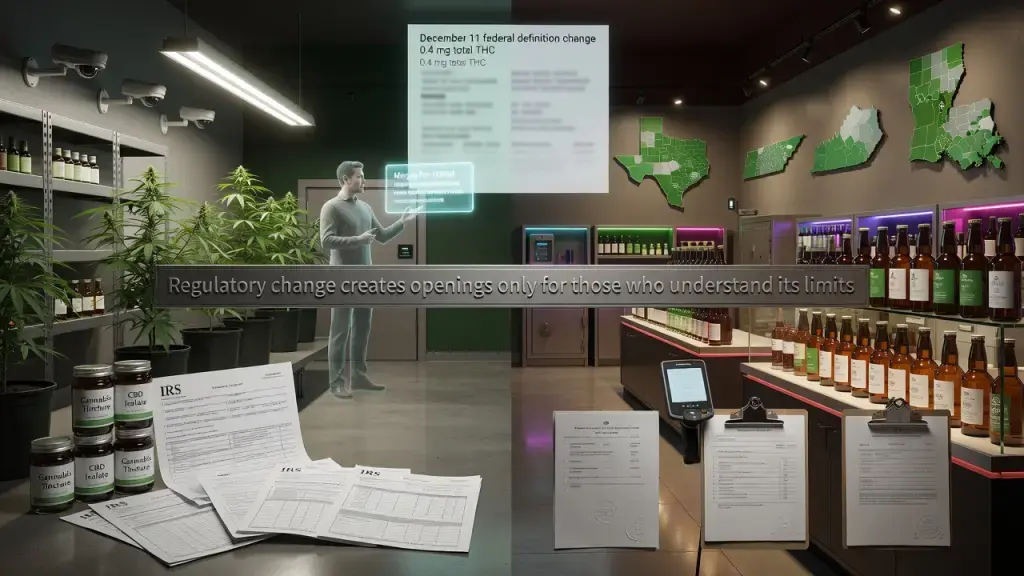
That regulatory patchwork is real and growing. Texas, Tennessee, Kentucky and Louisiana have each taken their own approach to THC beverage oversight, and a looming federal definition change - set to take effect Dec. 11 - would exclude many finished hemp-derived products exceeding 0.4 milligrams of total THC per container from the legal hemp definition entirely, unless Congress steps in.
What Operators Should Actually Do
The throughline for both marijuana and hemp beverage businesses is the same: regulatory change creates openings, but only for companies that understand the limits of that change before they build a strategy on top of it. For dispensary operators, multi-state companies, wholesalers and retail buyers, that means tracking federal registration requirements, 280E exposure, and state-by-state testing and labeling rules with the same rigor applied to seed-to-sale tracking or POS compliance - not waiting for Washington to hand down clarity that may not arrive on any predictable timeline.