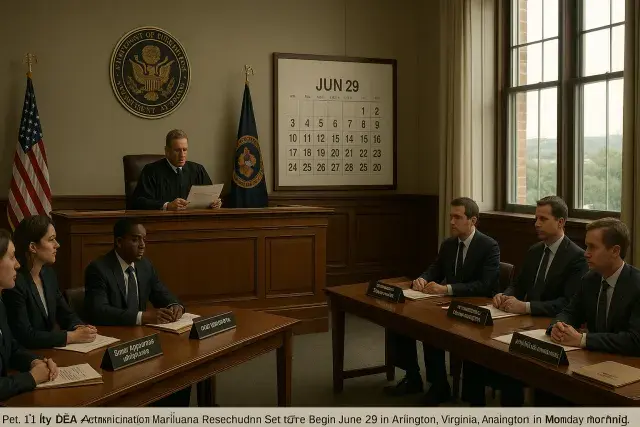
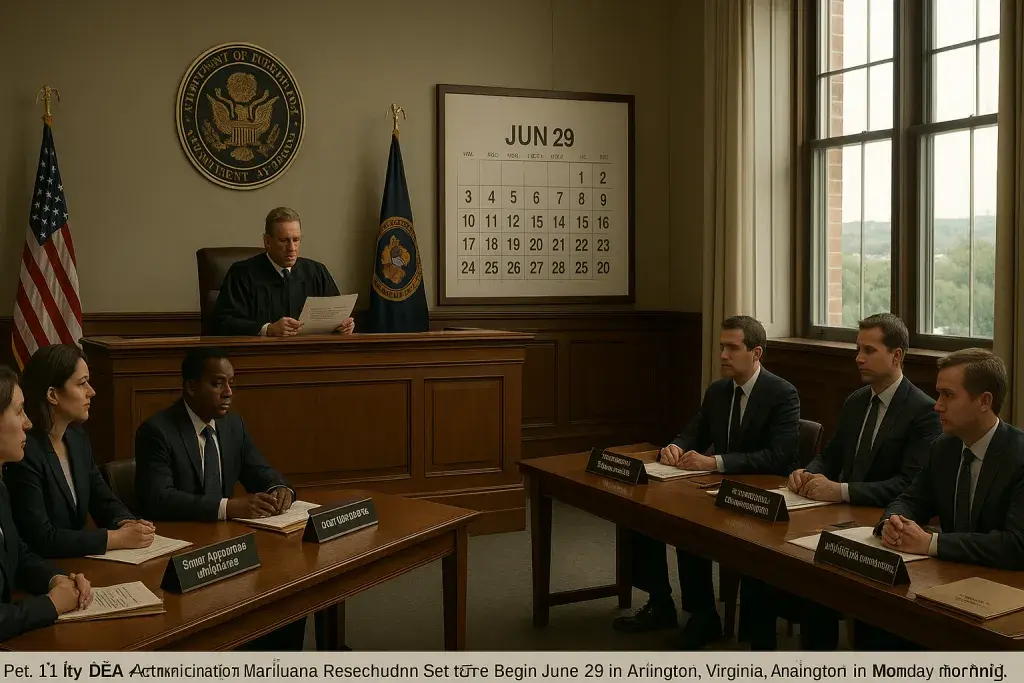
The federal administrative hearing on whether marijuana should be moved from Schedule I to Schedule III under the Controlled Substances Act has a firm date and a published schedule. Chief Administrative Law Judge Derek Julius confirmed that proceedings will open Monday, June 29, at the DEA Hearing Facility in Arlington, Virginia, with testimony expected to run through no later than July 15. For cannabis operators who have been watching this process stretch across multiple administrations, the calendar is, at minimum, a sign that something is actually moving.
The hearing structure matters as much as the dates themselves. The federal government presents its case first, on June 29, followed by a sequence of designated parties that includes the National Drug & Alcohol Screening Association, Smart Approaches to Marijuana, DUID Victim Voices, individual expert witnesses, the Tennessee Bureau of Investigation, and a coalition of states - Nebraska, Idaho, Indiana and Louisiana - on July 14. Most of these parties have historically opposed rescheduling or raised concerns about its public safety and enforcement implications. For licensed operators tracking this process through their dispensary inventory and POS system dashboards, federal reclassification remains a threshold event - one that could reshape everything from banking access to the tax code treatment of cannabis businesses under 280E.
Judge Julius was direct about the procedural ground rules: if a party finishes early or declines to use its allotted examination time, the hearing moves forward. No party, however, will be required to begin presenting on a date other than its assigned one. That's a reasonable guardrail - it prevents the schedule from collapsing into chaos if early sessions run short while protecting parties who built their preparation around a specific appearance date.
What This Hearing Is - and Isn't - About
Here's where the scope gets important. The hearing does not cover FDA-approved marijuana products or medical marijuana products regulated under qualifying state medical marijuana licenses. Those were already transferred to Schedule III in April under a separate order issued by Acting Attorney General Todd Blanche. What remains before Judge Julius is the broader question: should the remaining marijuana covered by the CSA - essentially the bulk of what flows through state-licensed commercial markets - also be reclassified to Schedule III?
That distinction is not a small one. The April reclassification of FDA-approved and state-licensed medical products represented a targeted regulatory action. Extending Schedule III status to the broader cannabis supply chain would be a materially different outcome - one with direct implications for how the federal government treats commercial cannabis businesses, how financial institutions assess their exposure to plant-touching operators, and whether Section 280E of the Internal Revenue Code continues to apply. Under 280E, cannabis businesses operating in Schedule I or II substances cannot deduct ordinary business expenses the way other retailers can. Rescheduling to Schedule III wouldn't automatically resolve 280E - that requires either legislative action or IRS interpretation - but it would change the legal foundation the provision rests on.
The Opposition Parties Signal a Real Contest
The parties scheduled to testify read less like a neutral stakeholder proceeding and more like a coordinated opposition effort. Smart Approaches to Marijuana has consistently argued against commercialization of cannabis at the federal level. DUID Victim Voices focuses on drugged driving. The Tennessee Bureau of Investigation and the four-state coalition - Nebraska, Idaho, Indiana and Louisiana - represent jurisdictions that have not legalized adult-use or, in some cases, any commercial cannabis market. Their inclusion signals that the hearing is not going to be a rubber stamp.
That's actually how administrative law is supposed to work. The DEA's proposed rescheduling was challenged, designated parties were selected, and the process moved to a formal evidentiary hearing. Whether the outcome favors reclassification or not, the procedural legitimacy here matters - particularly for an industry that has long argued it deserves the same regulatory coherence applied to other controlled substances.
What Operators Should Watch For
Multi-state operators, cannabis investors, and compliance professionals should monitor the hearing closely - not just for the outcome, but for the arguments the opposition actually makes on the record. The evidentiary record built during these proceedings will shape how any rescheduling order is defended against legal challenge after the fact. What the Tennessee Bureau of Investigation says on July 10, what expert witnesses argue on the 8th and 13th - those become part of the administrative record that courts will review if this ruling is challenged.
In practice, the July 15 end date means an actual ruling from the administrative law judge - and then DEA's final decision - likely comes weeks or months later still. That timeline should temper expectations. Rescheduling has been discussed seriously at the federal level for years; even a favorable outcome from this hearing is one step in a longer process. Operators building compliance frameworks, wholesale pricing models, or banking relationships on the assumption that federal reclassification is imminent would be wise to plan for the slower path.
The hearing begins Monday. The cannabis industry has seen a lot of promising signals evaporate in regulatory process. This time, at least, there's an actual schedule on the wall.