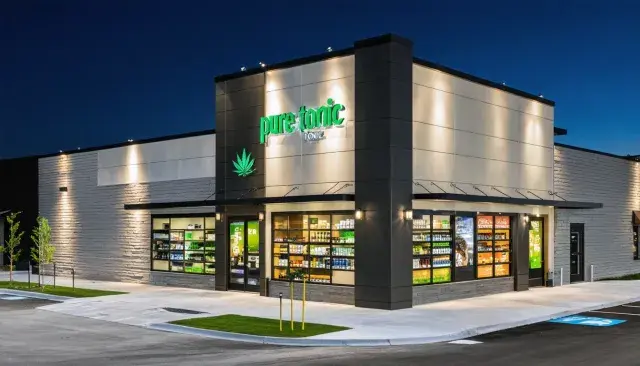

Glass House Brands, the California-based cultivator operating one of the largest cannabis greenhouses in the country, has applied to list on the New York Stock Exchange - and to do it, the company restructured its business to hold only medical marijuana operations. The move follows a model that Florida-based Trulieve Cannabis Corp. established, making Glass House potentially the second U.S.-licensed cannabis company to land on a major mainstream American exchange. The company filed supporting documents with the Canadian Securities Exchange, where it currently trades, outlining the separation of its adult-use retail arm into a distinct entity.
The mechanics here are worth walking through carefully. Glass House transferred its California adult-use retail operations into a subsidiary called Glass House Retail, in which a Glass House entity retains a 90% ownership stake while outside investor NSJB Investments acquired 10% for approximately $2.5 million, valuing the retail operation at roughly $20 million. That valuation sits against a backdrop of Glass House Brands reporting a $29.6 million net loss in 2025 on $181 million in revenue - numbers that reflect the brutal economics of California's licensed cannabis market, where high excise tax burdens, illicit market competition, and compressed wholesale pricing have squeezed even well-capitalized operators. For comparison, vertically integrated dispensary operators in other regulated markets - from the tight compliance environments tracked by tools like dispensary point of sale maine systems to multi-license MSO structures - have similarly wrestled with how to partition medical and adult-use revenue streams as federal policy shifts create new strategic openings.
What Glass House is doing isn't purely a financial engineering exercise. The company converted all of its California cannabis licenses to medical-only status and applied for a U.S. Drug Enforcement Administration registration - a step made available to state-compliant medical operators after the Justice Department's April 23 final order reclassified medical cannabis as a Schedule 3 controlled substance. That DEA designation is the regulatory thread connecting state-licensed medical operators to federal legitimacy, and it's the same thread Trulieve pulled to reach the NYSE. Glass House is also positioning itself for what it describes as a future in which medical cannabis export and interstate commerce between DEA-registered operators becomes feasible. The company has already sold its first hemp harvest and applied for an export license - moves that suggest it's building optionality across multiple regulatory scenarios rather than betting on a single policy outcome.
What the Corporate Structure Actually Looks Like
The separation between Glass House Brands and Glass House Retail is real but not clean. A Glass House subsidiary owns 90% of the adult-use retail entity, so the two companies remain substantially related. NSJB Investments, whose CEO is identified in California business records as Jared Beilke, holds the remaining 10%. Nicholas Sarris, Beilke, and Glass House founder and CEO Kyle Kazan all sit on the Glass House Retail board, per CSE filings. Whether that level of entanglement satisfies NYSE standards for separating federally problematic adult-use operations from a listed entity is precisely the question regulators and investors will be watching. The NYSE has not publicly spelled out a definitive bright-line test - Trulieve's listing set a precedent, but the exact criteria remain somewhat opaque.
The Cultivation Question No One Has Fully Answered
Here's the part that deserves more scrutiny. Glass House operates a 7-acre greenhouse in Carpinteria, Santa Barbara County - one of the largest cannabis cultivation facilities in California - that supplies its 10 retail locations. The company's investor deck states that "Glass House's remaining operations consist only of medical marijuana facilities licensed by the state of California and the DEA." But it isn't entirely clear, based on available disclosures, how the company divided cultivation output between medical and adult-use to satisfy NYSE standards. Cannabis cultivation at scale isn't easily bifurcated: seed-to-sale tracking systems log every plant, batch, and transfer, and separating medical from adult-use product flows requires distinct licensing, METRC entries, and compliant transfer manifests for each category. That operational detail matters - both to regulators evaluating the NYSE application and to any downstream compliance review.
A Regulatory Window - and Its Limits
The broader context matters here. The Trump Justice Department's final order rescheduling cannabis moved only medical marijuana to Schedule 3. The Biden-era proposal to reschedule all cannabis - adult-use included - was abandoned. DEA administrative law judge hearings on reclassification are scheduled to begin June 29, and further regulatory movement remains possible but not certain. Glass House's investor deck addresses this directly, noting that the company is preparing for multiple future scenarios - medical-only federal pathways, potential interstate commerce frameworks, and the hemp market as a hedge. That kind of multi-track positioning reflects how sophisticated cannabis operators are now thinking: not about a single regulatory outcome, but about building structures that survive several different ones. For operators across the industry - whether running a single dispensary or a multi-state portfolio - Glass House's restructuring offers a template worth studying, even if the NYSE listing itself remains pending and unconfirmed.