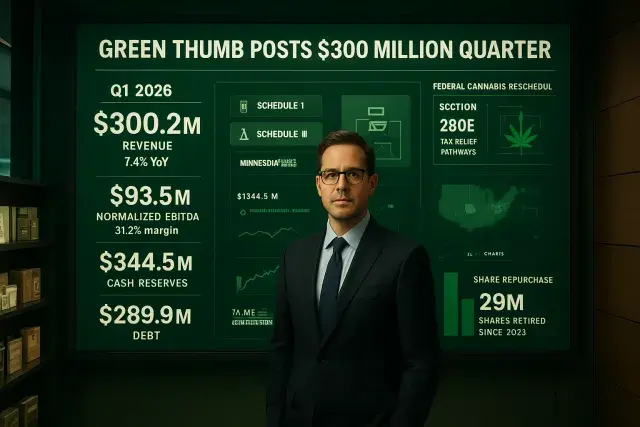
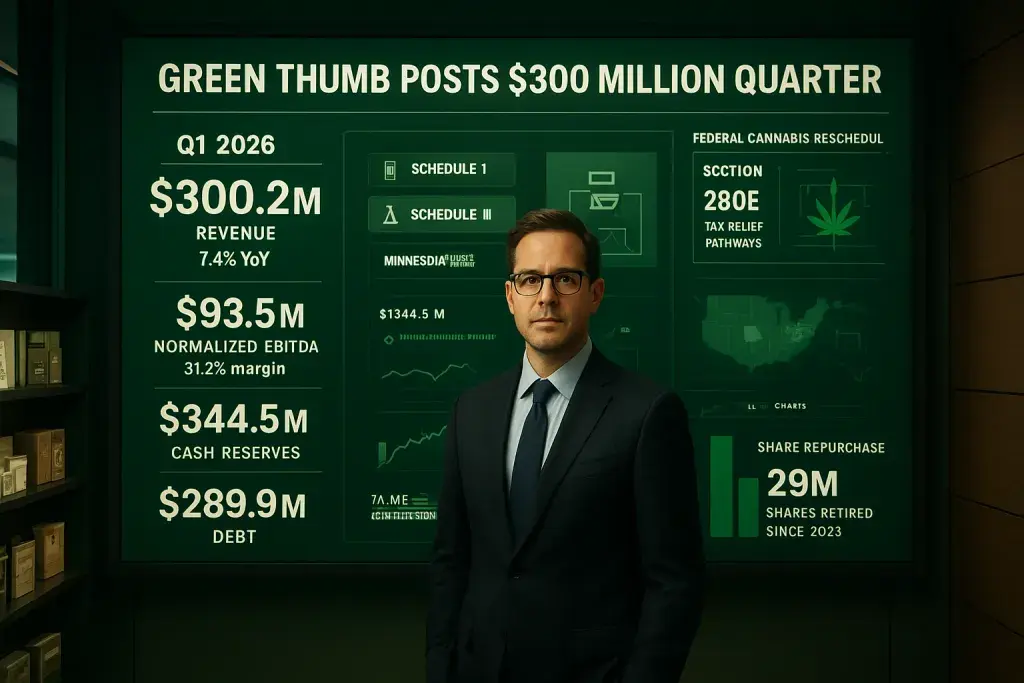
Green Thumb Industries reported first-quarter 2026 revenue of $300.2 million - a 7.4% year-over-year increase - as the Chicago-based multi-state operator absorbed both the financial lift of Minnesota's adult-use launch and the operational weight of persistent price compression across its wholesale business. Net income came in at $15.4 million, though a $17 million one-time arbitration settlement did meaningful work in getting it there. The bigger story, though, is what happens next: the federal rescheduling of medical cannabis from Schedule I to Schedule III has arrived, and Green Thumb is already moving to position itself for the tax relief and regulatory recalibration that follows.
For operators and investors tracking how large multi-state operators allocate capital under pressure, the balance sheet here is worth a close read. Green Thumb held $344.5 million in cash at quarter end against $289.9 million in total debt - a position that gives the company room to execute on share repurchases, expand its credit facility, and absorb the ongoing cost of vertical integration across 14 markets. The company repurchased approximately 6 million shares in Q1 for $33.3 million, then added another 7.4 million shares post-quarter, bringing year-to-date buybacks to roughly 13.4 million shares for approximately $77.7 million. Since September 2023, it has retired approximately 29 million shares at a total cost of around $200 million - a sustained capital return program that few cannabis companies have matched. Operators in competitive retail markets, from those running dispensary software arizona deployments to multi-unit RISE franchises in the Northeast, are watching how Green Thumb's financial discipline filters down into pricing strategy, wholesale terms, and store-level investment.
Normalized EBITDA of $93.5 million, or 31.2% of revenue, reflects a margin profile that most single-state operators would find difficult to match - largely because vertical integration, when it works, allows a company to capture value at cultivation, manufacturing, and retail simultaneously. The catch is that vertical integration also concentrates operational risk and capital requirements. Green Thumb's gross margin slipped from 51.3% in Q1 2025 to 47.9% in Q1 2026, driven in part by brand license fees now running through cost of goods and continued wholesale price compression. That compression is a structural reality across most regulated cannabis markets, not a Green Thumb-specific problem. When cultivation capacity outpaces demand - or when adult-use licensing expands faster than consumer spending - wholesale pricing erodes, and vertically integrated operators feel it on both sides of the ledger.
Rescheduling and 280E: What Actually Changes for Licensed Operators
The federal rescheduling of medical cannabis to Schedule III is the most consequential regulatory development for licensed cannabis businesses since state-level adult-use legalization began in earnest. The mechanism that matters most for operators is Section 280E of the Internal Revenue Code. Under Schedule I, cannabis businesses have been barred from deducting ordinary business expenses - compensation, rent, marketing, administrative costs - leaving them with effective federal tax rates that can far exceed those of comparable consumer goods companies. Rescheduling to Schedule III doesn't eliminate 280E's application outright, but it creates a pathway for medical cannabis operations to begin claiming expense deductions associated with that portion of their business. Green Thumb President Anthony Georgiadis described the result as "meaningful flexibility to reinvest in our operations, our people, and the communities we serve." That's not spin - for a company with $300 million in quarterly revenue, even a partial reduction in effective tax burden translates into real dollars that can flow toward capital expenditures, headcount, or debt service.
Green Thumb also disclosed it has submitted DEA registration applications for certain state-licensed medical cannabis operations following rescheduling - a procedural step that reflects how seriously the company is treating federal compliance as a new operational layer. This matters beyond Green Thumb. Any multi-state operator with medical cannabis operations will need to think carefully about DEA registration timelines, state-federal compliance overlap, and how their existing seed-to-sale tracking systems interact with federal reporting expectations that didn't previously apply. Compliance teams and cannabis-specific software vendors alike should expect that rescheduling creates new documentation requirements, not fewer of them, in the near term.
Minnesota Adult-Use, Same-Store Sales, and the Retail Reality
The launch of adult-use sales in Minnesota on September 17, 2025, contributed meaningfully to Green Thumb's retail revenue growth in Q1 2026. So did continued expansion in Connecticut and Florida. But same-store comparable sales - the metric that strips out new store openings and market launches to reveal organic performance - declined 0.5% year-over-year on a base of 100 stores. That's a small number, and in isolation it isn't alarming. In context, though, it reflects the broader pressure that established dispensaries face as new licenses enter their markets and average transaction values soften due to lower retail pricing.
Green Thumb's consumer packaged goods gross revenue also fell 1.6% versus the prior year, a reminder that brand strength doesn't fully insulate wholesale businesses from pricing dynamics. The company's portfolio - which includes RYTHM, Dogwalkers, incredibles, Beboe, and others - competes in markets where shelf space is contested and buyers have more options than they did two years ago. For wholesale brands operating at any scale, the margin on individual SKUs is tightening, and route-to-market efficiency matters more than it used to.
Texas and the Longer Arc of Market Expansion
After quarter end, Green Thumb was conditionally awarded a Texas Compassionate Use Program license for vertically integrated operations. Texas's CUP remains one of the most restrictive medical cannabis programs in the country - a small patient base, limited qualifying conditions, and a tightly controlled license structure. It is not a near-term revenue driver of any significance. What it is, is a foothold. If Texas ever broadens its medical program or moves toward adult-use, operators already holding vertically integrated licenses will be positioned ahead of new entrants. Green Thumb has demonstrated repeatedly that it treats early-stage license awards as long-duration assets - expensive to acquire and hold, but valuable if the regulatory environment shifts. Texas is a bet on that thesis, not a near-term earnings contributor.
For dispensary operators and B2B vendors watching Green Thumb's trajectory, the Q1 numbers tell a story about what disciplined execution looks like in a maturing, federally constrained market. Revenue growth of 7.4% is real. The 280E relief coming from rescheduling is real. The same-store sales pressure and margin compression are also real. None of those things cancel each other out - they coexist, which is how regulated cannabis retail actually works at scale.