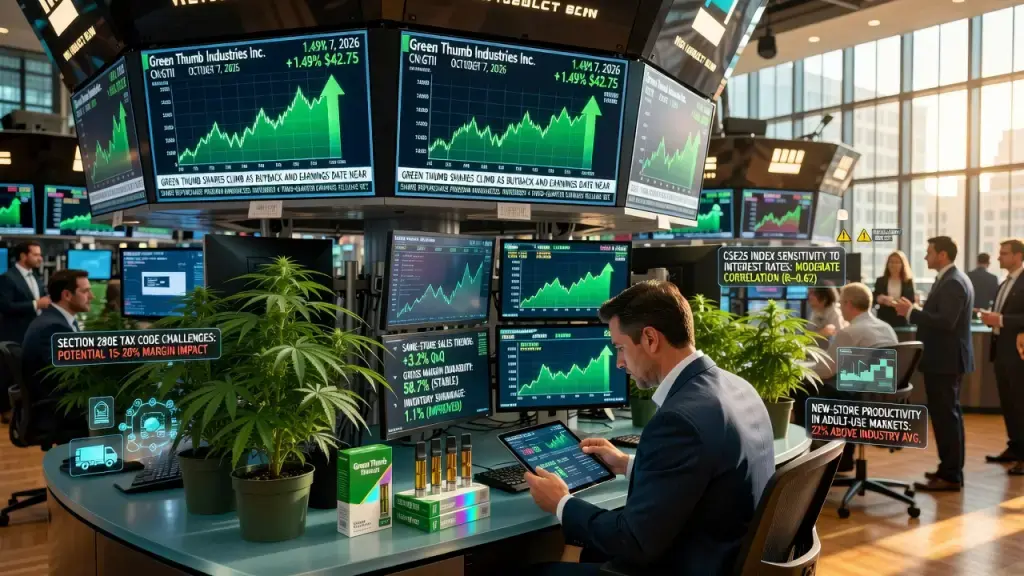
Green Thumb Industries Inc. (CN:GTII) shares advanced 1.49% on October 7, 2026, as investors weighed a recently announced share repurchase program against the backdrop of a November 4 third-quarter earnings release. The move puts the multi-state cannabis operator back on trading desks' radars at a moment when the broader CSE25 Index remains sensitive to interest rates, commodity costs and consumer demand.
Why a Buyback Matters for a Plant-Touching Operator
A share repurchase program is a fairly ordinary corporate finance tool in most sectors. For a cannabis multi-state operator, though, it carries a different weight. These companies still operate under Section 280E of the federal tax code, which disallows standard business expense deductions for businesses trafficking in a federally controlled substance. That makes effective cash management, not just revenue growth, the real test of operational health. A buyback signals management's confidence that cash generation from dispensary sales, wholesale distribution and branded product lines is durable enough to return capital to shareholders rather than hoard it for regulatory contingencies or expansion capital needs.
In practice, though, a buyback announcement alone does not confirm execution. Investors watching CN:GTII will want to see the repurchase actually carried out against disclosed authorization limits, not merely announced and left dormant. That distinction - announced versus executed - tends to separate credible capital-return stories from symbolic ones.
What the November 4 Print Needs to Show
The scheduled third-quarter results will be parsed less for topline revenue and more for same-store sales trends, new-store productivity and gross margin durability. Retail expansion in cannabis is not simply a matter of opening doors; new dispensary locations face ramp-up periods tied to local market saturation, pricing competition and the time it takes a store to build repeat traffic. A store that opens strong in a newly legalized adult-use market can still underperform if neighboring license holders compress wholesale pricing or if local tax structures erode margin at the point of sale.
Analysts and operators alike also track inventory shrinkage, compliant packaging costs and seed-to-sale tracking overhead - the kind of granular, compliance-driven expense lines that do not show up in a headline revenue number but shape actual profitability. For a vertically integrated operator like Green Thumb, which touches cultivation, processing and retail, these costs compound across the supply chain rather than sitting in one line item.
Reading the Stock Against Its Benchmark
A single-day gain of under two percent is not, by itself, confirmation of a new trend. What matters more is whether CN:GTII's move reflects company-specific attention - the buyback, the approaching earnings date - or simply tracks a broadly constructive session across the CSE25 Index. If the stock continues to outperform its benchmark over several sessions, that is a cleaner signal of durable investor interest than one day's print.
The risks cutting the other way are familiar to anyone who follows U.S. cannabis equities: regulatory uncertainty at the federal level, state-by-state licensing shifts, competitive pricing pressure in maturing adult-use markets, and financing costs that remain elevated relative to traditionally banked industries because federal illegality still limits access to conventional capital markets and interstate banking services.
What Operators and Investors Should Watch Next
- Whether the buyback program shows measurable share-count reduction by the next reporting period
- Same-store sales growth versus new-store contribution to overall revenue
- Gross margin trends amid wholesale price competition in mature markets
- Any regulatory developments affecting interstate commerce, banking access or federal scheduling
- Balance-sheet flexibility heading into the November 4 earnings release
None of these factors resolve on a single trading day. The near-term setup looks constructive, but the harder test - whether a repurchase program and a retail footprint expansion translate into sustained earnings quality - plays out over the coming quarters, not the next session.