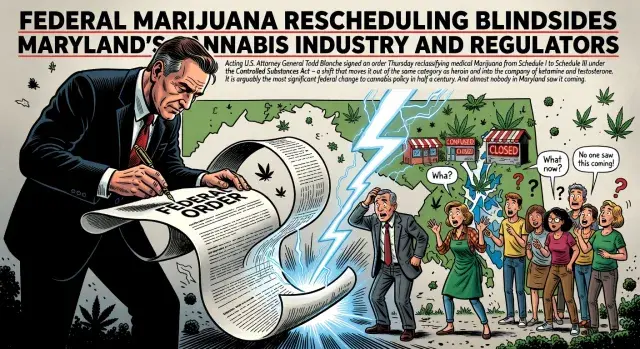

The DEA and DOJ have moved FDA-approved and state-regulated medical marijuana products from Schedule I to Schedule III under the Controlled Substances Act - a federal policy shift decades in the making that stops well short of full legalization but carries real weight for clinical research, drug development pipelines, and how medical cannabis eventually reaches patients. Recreational marijuana remains federally illegal. That distinction matters enormously for how operators, researchers, and healthcare stakeholders interpret what changed and what didn't.
What Schedule III Actually Means - and What It Doesn't
Schedule I classification had long been the structural barrier that made serious pharmaceutical-grade cannabis research extraordinarily difficult. Researchers seeking to study a Schedule I substance faced a layered approval process, supply restrictions, and institutional barriers that other therapeutic compounds simply didn't encounter. Moving qualifying medical marijuana products to Schedule III removes some of that friction - not all of it, but enough to open doors that were effectively sealed.
Schedule III substances are still controlled. They carry federal oversight, manufacturer registration requirements, and prescribing restrictions. The difference is that the regulatory burden is materially lower than Schedule I, and that gap is where clinical research starts to breathe. Drug developers who have been watching cannabis-derived compound pipelines from a cautious distance now have a more workable federal framework to operate within.
Here's the catch, though: recreational cannabis products don't fall under this rescheduling. Adult-use dispensaries, the operators who run them, and the supply chains that serve them are not operating under a newly permissive federal posture. The IRS's 280E tax provision - which disallows standard business deductions for companies trafficking in Schedule I or II substances - theoretically becomes less punishing for medical cannabis operations specifically. But the full picture of how that interacts with state-licensed adult-use businesses remains legally unsettled.
The Research Pipeline Opens, Cautiously
For pharmaceutical companies, biotech firms, and academic research institutions, Schedule III status means cannabis-derived compounds can be studied under a framework closer to how other controlled medications are developed and eventually approved. That changes the economics of drug development. Clinical trials are expensive; the compliance overhead of Schedule I status made cannabis research disproportionately costly relative to therapeutic areas with comparable development complexity.
What this doesn't do is fast-track any particular compound through FDA approval. The standard drug development pathway - preclinical work, phased clinical trials, efficacy and safety review - applies in full. Rescheduling reduces regulatory friction at the intake end of the pipeline. It does nothing to compress timelines on the back end. Any operator or investor expecting near-term approved cannabis-derived pharmaceuticals to flood clinical settings is reading the situation wrong.
The more immediate implication is that research institutions, pharmaceutical sponsors, and contract research organizations now face fewer bureaucratic obstacles when designing studies. More research getting funded and conducted means better evidence on therapeutic applications - and better evidence is ultimately what shapes prescribing practice, formulary inclusion, and third-party reimbursement policy.
Downstream Implications for Patient Care and Dispensary Operations
The downstream path from rescheduling to actual patient care is long, and the industry should be clear-eyed about that. Medical cannabis operators - dispensaries holding medical licenses, pharmacist-supervised dispensing facilities, and vertically integrated medical cannabis businesses - are the most directly affected retail-side stakeholders. Rescheduling doesn't automatically change state-level medical programs, compliance requirements, or how physicians recommend cannabis products. Those frameworks are state-governed and vary considerably.
What changes over time, if the research pipeline delivers, is the evidentiary base that clinicians use to make patient care decisions. Right now, many physicians operate in an informational gap - state-legal medical programs exist, patients ask questions, but peer-reviewed clinical evidence has been thin by pharmaceutical standards. A more accessible research environment should, over years, produce data that brings cannabis-based treatments closer to evidence-based medicine as it's practiced in mainstream healthcare settings.
For medical dispensary operators, that's a meaningful long-term development. Insurance reimbursement for cannabis products - essentially nonexistent under the old federal framework - could eventually become a serious policy conversation if approved formulations gain FDA-recognized status. That would reshape the economics of medical cannabis retail in ways that wholesale pricing structures, inventory management systems, and POS platforms are not currently built to handle. Operators would be wise to watch those policy signals now rather than scramble to adapt later.
What Stakeholders Should Be Assessing Now
The honest read on this rescheduling is that it's a significant regulatory inflection point, not an immediate operational overhaul. The stakeholders best positioned to benefit early are pharmaceutical developers, clinical research sponsors, and medical cannabis businesses with the compliance infrastructure to engage with an evolving federal framework. Adult-use operators are largely watching from the sideline - still subject to the same state-level compliance obligations, the same banking friction, and the same federal illegality that has defined the industry's operating environment.
That said, policy momentum builds on itself. The rescheduling creates a template - and a legal and scientific record - that could inform how regulators eventually evaluate recreational marijuana's federal status. Operators across both medical and adult-use markets should be auditing how their compliance frameworks, licensing structures, and business models would be affected by further federal movement. The regulatory wheels, as the DOJ process demonstrated, can move faster than many in the industry expect.
To put it plainly: this rescheduling matters most for the long game. Clinical research, drug development, patient care pathways, and eventually reimbursement policy - those are where the real structural changes will unfold. For dispensary operators running budrooms today, the practical impact is limited. For the medical cannabis industry's future, the implications are worth taking seriously.