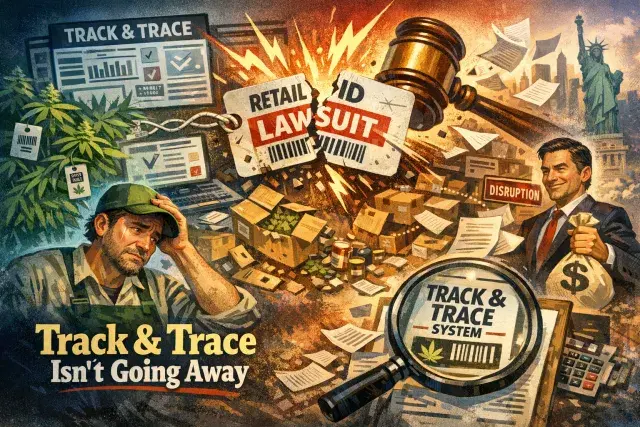

Michigan's Cannabis Regulatory Agency has filed a formal complaint against VJAS 1, a licensed cannabis processor operating in Harrison Township, after an inspection uncovered more than 12,000 individual cannabis products with no Metrc tags or any other form of identifying information. Among those untagged products were items in California-specific packaging - bearing the letters "CA" and California-mandated warning language - raising immediate questions about how out-of-state inventory ended up inside a licensed Michigan facility. The CRA is now pursuing fines and potential suspension, restriction, revocation, or non-renewal of VJAS 1's license.
What makes this case particularly striking is the scale. Twelve thousand untagged units isn't a clerical gap or a labeling backlog - it's a systemic breakdown of seed-to-sale accountability. Metrc, Michigan's mandatory track-and-trace platform, exists precisely to prevent unverified cannabis from entering the licensed supply chain. Every compliant product at every licensed facility is supposed to carry a Metrc tag that ties it to a specific batch, a specific licensed source, and a documented chain of custody. When investigators cross-referenced the products that did carry tags, they found those items were supposed to be physically located at entirely different cannabis businesses - a finding that compounds the compliance failures significantly. The California packaging angle adds another layer: state-licensed markets are closed systems, and products manufactured and labeled for California's regulatory environment - where operators rely on tools like dispensary pos software california to maintain compliant inventory records - have no legal pathway into Michigan's supply chain.
Why Untagged Inventory Is a Red Flag, Not a Gray Area
In a regulated cannabis market, an untagged product is essentially contraband. That's not hyperbole - it's the operational logic of seed-to-sale compliance. Metrc tags are assigned at the point of cultivation or manufacture, travel with the product through every transfer, and allow regulators, processors, and retailers to verify origin, testing status, and chain of custody at any point in the supply chain. Without that tag, there is no way to confirm whether a product was tested for potency, residual solvents, pesticides, or microbial contamination. Consumer safety, in that sense, is inseparable from inventory tracking.
The fact that employees at VJAS 1 were reportedly unable to explain the presence of so many untagged products only sharpens the concern. Operators at licensed facilities are expected to maintain accurate inventory logs - typically reconciled through their Metrc integration and point-of-sale or back-office systems. A discrepancy of this magnitude doesn't materialize overnight. It suggests either a prolonged failure of internal controls, deliberate circumvention, or both. Regulators are right to treat the latter as a live possibility.
What This Means for Licensed Operators Watching From the Sidelines
For dispensary owners, processors, and multi-state operators, this case is a useful - if uncomfortable - reminder of how quickly a licensing situation can deteriorate. License suspension or revocation isn't just a regulatory outcome; it's a business-ending event. Wholesale relationships collapse, employees lose positions, and any equity built in the license itself is put at risk. The potential for license non-renewal alone carries long-term consequences in a market where licensing caps and application timelines make re-entry difficult.
The presence of out-of-state packaging also points to a broader supply chain risk that Michigan is clearly taking seriously: the infiltration of gray or illicit-market product into the licensed channel. This isn't unique to Michigan - regulators across multiple legal markets have confronted the problem of unverified inventory moving through nominally licensed facilities. It distorts wholesale pricing, undercuts compliant operators who carry the full cost of testing and tracking, and exposes consumers to products that have never been reviewed by a state-certified testing lab.
The Compliance Infrastructure Gap Licensed Facilities Cannot Afford
Cases like this one tend to expose a gap between what a license permits and what an operator has actually built in terms of internal compliance infrastructure. Obtaining a processing license is one thing. Maintaining the operational discipline to reconcile Metrc data daily, audit physical inventory against digital records, and flag discrepancies before they compound - that's an entirely different capability. Smaller operators, in particular, sometimes underinvest in this infrastructure, whether due to cash flow pressure, staffing limitations, or an underestimation of how closely regulators will scrutinize their facilities.
The VJAS 1 case should recalibrate that calculus. Michigan's CRA has demonstrated it is willing to pursue formal complaints with significant license consequences - not simply issue a warning and move on. For any licensed Michigan processor or retailer still running manual inventory reconciliation or treating Metrc compliance as a back-burner task, this is a concrete demonstration of what enforcement actually looks like.