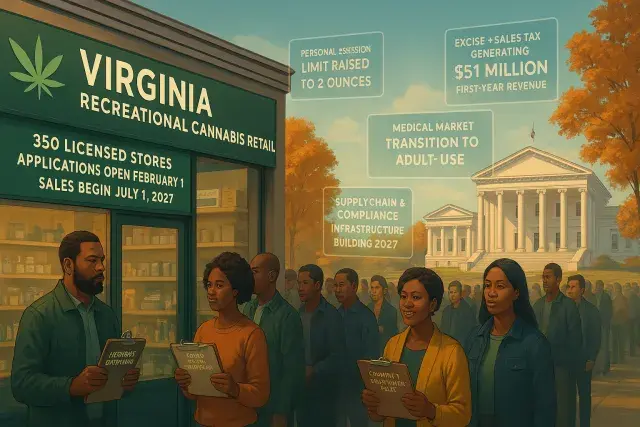
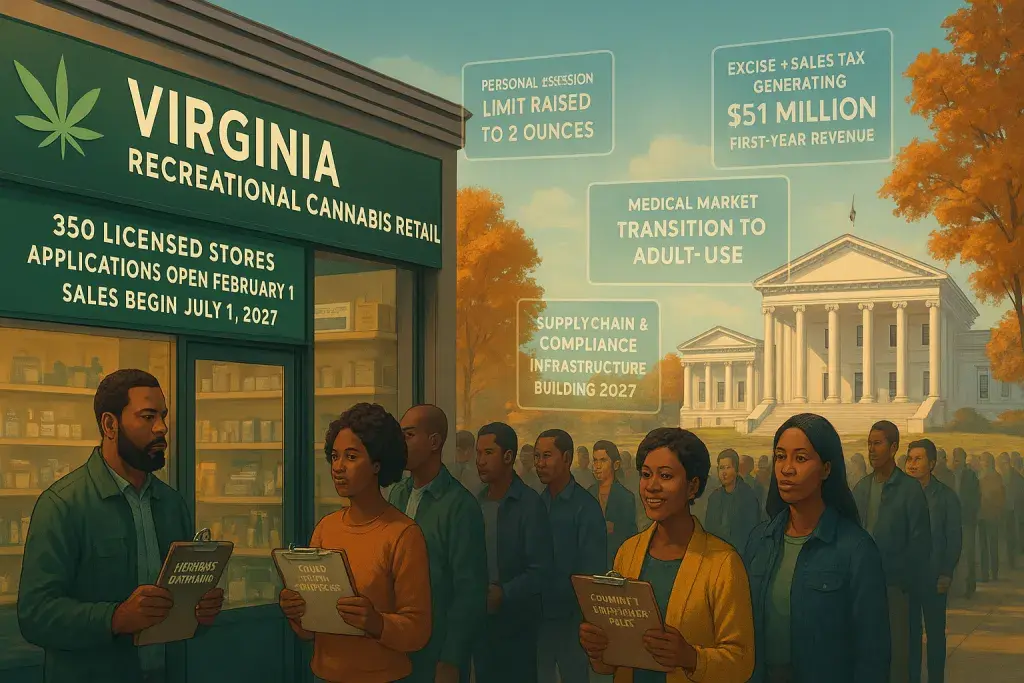
Virginia has cleared the final legislative hurdle to launch a regulated adult-use cannabis retail market - and the clock is already running. State budget legislation signed into law this week caps the initial market at 350 licensed retail stores, sets a licensing application window opening February 1, and fixes July 1, 2027, as the date when recreational sales to adults 21 and older can legally begin. For dispensary operators, multi-state operators scouting new markets, and ancillary vendors eyeing the Mid-Atlantic, the message is straightforward: Virginia is open, but the window to position is finite.
The state's path here was anything but direct. Virginia legalized adult possession in 2021 - the first Southern state to do so - but failed for years to build a functioning retail framework around that decision. A Republican governor vetoed retail legislation in 2024. The result was a four-year gap in which legal possession existed without legal purchase, a structural contradiction that predictably drove consumer dollars toward unlicensed sellers. Operators building out retail technology stacks in adjacent regulated markets - including those using platforms like IndicaOnline POS New Jersey - have watched Virginia's stalled rollout as a cautionary example of what happens when possession law races ahead of retail infrastructure. That gap is now closing, though the 2027 start date gives the state roughly two years to build the compliance, licensing, and market architecture that other states took years longer to develop.
Here's the practical shape of what's been approved. The law raises the personal possession limit from one ounce to two ounces, preserves home cultivation rights, and layers an excise tax on top of the existing state sales tax. Legislative budget documents project that combined tax structure will generate approximately $51 million in state revenue during the program's first year. For operators modeling unit economics, that excise-plus-sales-tax structure is familiar from markets like Colorado, Illinois, and Massachusetts - and it has real implications for retail pricing strategy, wholesale margin compression, and competitive positioning against the illicit market, which carries no tax burden at all.
What the License Cap Means for Operators and Vendors
A hard cap of 350 retail licenses is a meaningful constraint. To put it in context, Virginia is a large state by population - around 8.7 million residents - and 350 stores statewide would represent a relatively low initial store density compared to adult-use markets that have been operating for several years. That scarcity has two effects that operators and investors should think through carefully.
First, license value goes up. In capped markets, retail licenses tend to carry a premium - both on initial award and in secondary transactions. That creates pressure on applicants to build strong applications early, particularly around social equity criteria, which are embedded in Virginia's legislative framework. State Sen. Lashrecse Aird and other Democratic architects of the law have been explicit that equity - specifically correcting the documented pattern of disproportionate marijuana enforcement against Black Virginians - is a policy priority, not an afterthought. Applicants that understand the state's equity scoring rubric and structure their ownership, staffing, and community-investment plans accordingly will have an edge when regulators begin reviewing applications after February 1.
Second, vendors get a bounded market with a clear go-live date. Point-of-sale providers, seed-to-sale compliance software companies, compliant packaging manufacturers, payment processors, and real estate brokers all have a defined horizon to work toward. The February 2026 application opening - set roughly 17 months before the retail launch date - creates a procurement window. Operators awarded licenses will need to stand up their technology stack, negotiate wholesale supply agreements with licensed cultivators and processors, and build out physical retail footprints, all before the first legal sale on July 1, 2027.
The Medical Market Transition and Supply Chain Pressure
Virginia already operates a functioning medical cannabis program, and that infrastructure matters. Existing medical dispensary operators - who have already built seed-to-sale compliance workflows, established supplier relationships, and trained staff on regulated retail protocols - will be positioned to move quickly if they receive adult-use retail licenses. That's not automatic, though. Adult-use retail introduces product volume, SKU diversity, consumer demographics, and compliance requirements that differ from a medical patient population.
The state's licensed cultivators and processors will also face a step-change in demand the moment recreational sales begin. Supply chain undersupply has plagued early-stage adult-use markets in several states, causing retail shelves to thin out precisely when consumer interest peaks. Virginia regulators and operators alike have time to study those rollout failures and plan production capacity accordingly - but that planning has to start well before 2027.
Product safety and labeling compliance will be non-negotiable from day one. Adult-use products must carry accurate potency data, compliant packaging, and documentation traceable through the state's regulatory system. Operators who have worked in medical cannabis know what a certificate of analysis looks like and why batch-level lab testing matters; the adult-use expansion means those standards will apply across a much larger and more diverse product catalog.
The Equity and Enforcement Tension Operators Should Watch
The legislation isn't without friction points. Legalization advocates broadly welcomed the law, but objected to one specific provision: an increased civil fine for public cannabis consumption. The concern - raised publicly by grassroots groups including Marijuana Justice - is that a higher fine could reproduce the same racially disproportionate enforcement patterns that made marijuana criminalization so contentious in Virginia in the first place. Gov. Abigail Spanberger ultimately incorporated her amendments into a budget compromise rather than signing standalone retail legislation, and the public-consumption fine increase traveled with that package.
For retail operators, this tension has a practical dimension. If enforcement of public-consumption rules becomes a visible issue after sales launch, it will drive political attention back to the program and potentially constrain how operators market store proximity, consumption culture, or product convenience. Responsible retailing norms - clear signage on consumption restrictions, staff trained on age verification, and rigorous ID protocols - are standard compliance practice in every adult-use state. In Virginia, given the equity backdrop, operating visibly above minimum compliance standards will be both good policy and good business.
Virginia isn't moving in isolation, either. It enters adult-use retail as the federal reclassification debate continues - with the Trump administration signaling movement on how medical cannabis is categorized at the federal level, though full federal legalization remains off the table. The state-federal mismatch still affects banking access, 280E tax treatment for cannabis businesses, and payment infrastructure for retail operators. None of that resolves in 2027. But Virginia's regulated market - with tested products, licensed sellers, and a state tax structure - is a materially better environment than the illicit market it is designed to displace, and that, as one state legislator put it, is the point.