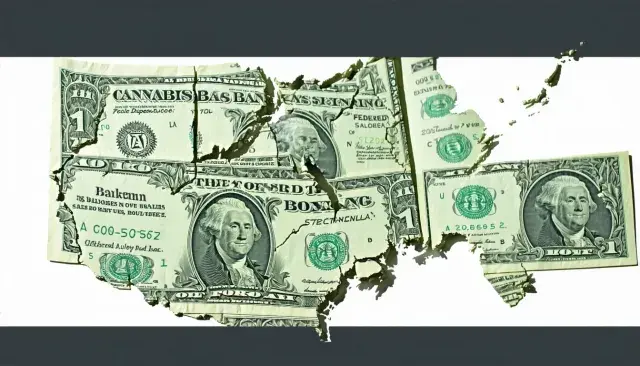
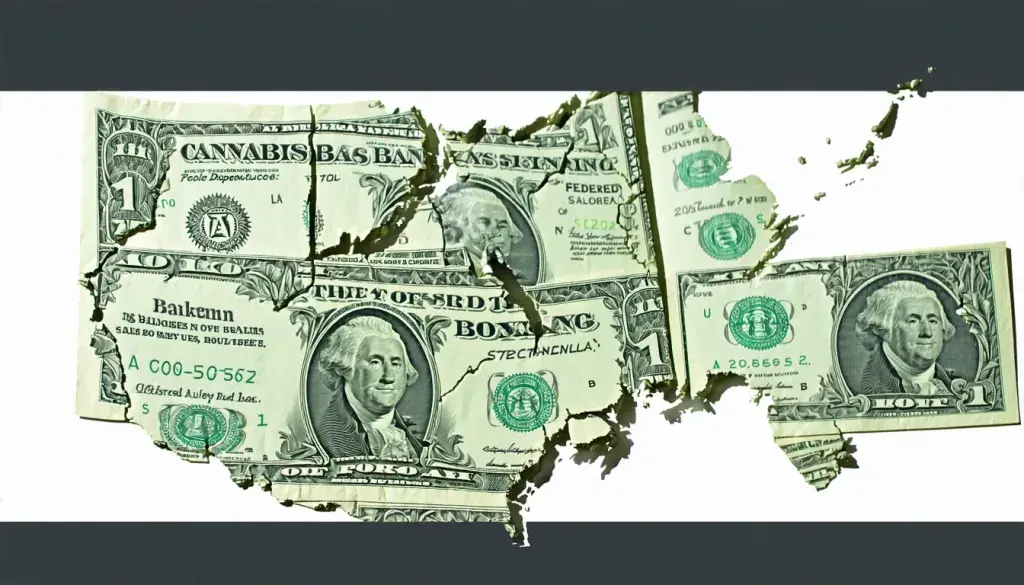
More than half the country has legalized marijuana for adult use, and the money is real - Ohio alone saw consumers spend over $131 million at dispensaries in the first three months of its adult-use program. Yet the businesses collecting that money often cannot deposit it in a bank, cannot process credit cards, and cannot pay employees without hauling cash. That contradiction is not an oversight. It is the direct, foreseeable consequence of marijuana remaining a Schedule I controlled substance under federal law, and resolving it has proven stubbornly resistant to every legislative attempt so far.
Why Banks Won't Touch Marijuana Money
The core problem sits at the intersection of three overlapping federal frameworks, each of which creates independent liability for any financial institution that serves a marijuana-related business (MRB). The Controlled Substances Act classifies marijuana alongside heroin and LSD - no accepted medical use, high abuse potential - which means revenues from its sale are, by definition, proceeds from a federal crime. The Bank Secrecy Act then requires banks to monitor for exactly that kind of illegal activity and file suspicious activity reports (SARs) with the Treasury Department's Financial Crimes Enforcement Network, known as FinCEN. And federal anti-money laundering statutes make it a criminal offense for a bank employee to knowingly handle those proceeds - not just in bulk, but in ordinary transactions. Withdrawing funds from a dispensary's checking account to cover payroll could, under 18 U.S.C. § 1956, expose that employee to criminal prosecution.
FinCEN tried to thread this needle in 2014 with guidance establishing a tiered SAR framework for MRBs: a "marijuana limited" SAR for businesses operating within state law, a "marijuana priority" SAR for those implicating enforcement concerns, and a "marijuana termination" SAR when a bank decides it has to walk away entirely. Fair enough as bureaucratic machinery goes - but guidance is not law, and it does nothing to remove the underlying criminal exposure. Banks are still taking on legal risk every time they open an account for a dispensary, and most have concluded the math does not work.
A Decade of Legislative Near-Misses
Congress has been aware of this impasse for years. The Secure and Fair Enforcement (SAFE) Banking Act passed the House seven times between 2019 and 2022 - seven times - and died in the Senate each time. The expanded Secure And Fair Enforcement Regulation (SAFER) Banking Act, introduced in 2023, would have created a statutory safe harbor for financial institutions serving state-sanctioned MRBs, shielding them from criminal, civil, and administrative penalties. Marijuana would have remained federally illegal under the SAFER Act; the bill was explicitly not a legalization measure. It simply asked Congress to stop treating community banks as criminal conspirators for serving a legal business in their state. That has not been enough to clear the Senate.
The Marijuana Opportunity Reinvestment and Expungement (MORE) Act takes the bolder route - removing marijuana from the CSA's schedules entirely, decriminalizing it at the federal level, and eliminating the conflict between state and federal law that produces the banking problem in the first place. The House passed it in 2020 and again in 2022. It has not moved in the Senate. What's striking here is the pattern: the House has repeatedly demonstrated it can assemble a majority on cannabis reform, and the Senate has repeatedly demonstrated it cannot, or will not.
The Executive Order and What It Actually Does
On December 18, 2025, President Trump signed Executive Order 14370, directing the Attorney General to reclassify marijuana from Schedule I to Schedule III under the CSA. Schedule III substances - anabolic steroids, certain codeine formulations - carry a moderate to low potential for dependence. The reclassification, if it proceeds through the required regulatory process, would mark the most significant shift in federal marijuana policy in decades.
Here's the catch, though: the executive order's stated purpose is expanding research access, not banking reform. Rescheduling to Schedule III would not make marijuana legal under federal law - it would remain a controlled substance, merely a differently categorized one. The anti-money laundering statutes, the Bank Secrecy Act obligations, the FinCEN reporting requirements - none of those evaporate with rescheduling. An MRB's revenues would still derive from a federally controlled substance, and the legal exposure for banks that serve them would remain substantially intact. The executive order may revitalize congressional momentum around cannabis banking, as some in the industry hope, but it does not itself solve the problem.
Enforcement discretion fills the remaining gap - and that has always been unstable ground. The Obama administration's 2013 Cole Memorandum deprioritized marijuana prosecutions; Attorney General Jeff Sessions rescinded it in 2018. What a memo gives, a memo can take away. The current administration's posture appears more accommodating than Sessions-era DOJ, but that is a political condition, not a legal one. Any MRB, and any bank considering serving one, is ultimately betting on the continuity of prosecutorial forbearance rather than the protection of statute.
The Stakes of Staying Cash-Only
Operating as a cash-only industry at this scale creates problems that extend well beyond inconvenience. Cash businesses are harder to audit, easier to rob, and more difficult to insure. They generate safety risks for employees and owners who must physically transport large sums. They also create opacity that undermines the very argument the industry makes for legitimacy - that state-regulated cannabis is a transparent, taxable, accountable commercial sector. Without banking access, that argument runs into its own structural contradiction.
Billions of dollars in state tax revenues have flowed from legal cannabis sales, which is a figure that legislators in cannabis states are acutely aware of and protective of. The pressure to fix the banking problem is not abstract. It comes from chambers of commerce, state revenue departments, and small business owners who built legal enterprises under state law and cannot get a checking account. Whether the current executive action translates into durable legislative reform - or simply raises expectations that stall again in the Senate - is the question the industry has been asking, in various forms, for the better part of a decade.