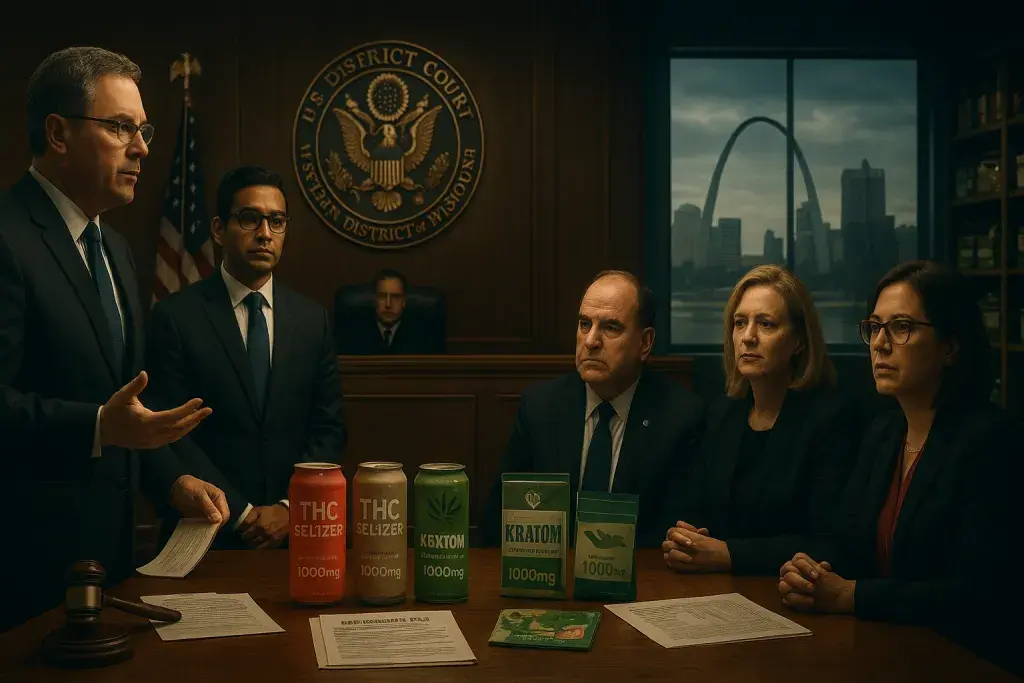
A coalition of Missouri hemp businesses filed a federal lawsuit Thursday targeting a state law that would remove all intoxicating hemp products from retail shelves on November 12. The suit, filed in the U.S. District Court for the Western District, argues the legislation - House Bill 2641, signed earlier this year by Gov. Mike Kehoe - contains definitions so internally contradictory that businesses, law enforcement, and prosecutors cannot determine which products are legal and which are not. The stakes are immediate: the bill covers everything from THC seltzers sold in grocery stores to products currently moving through unlicensed smoke shops.
The plaintiffs include St. Louis-based MNG 2005, Inc., the parent company behind 55 CBD Kratom retail locations nationwide; the Missouri Hemp Trade Association; and Wisconsin-based Lifted Liquids Inc. For multi-state operators managing compliance across dozens of storefronts - the kind of businesses that depend on consistent regulatory frameworks the way licensed dispensaries depend on dispensary software in Montana or any other regulated state to maintain accurate inventory and stay audit-ready - vague statutory language isn't a technicality. It's a direct operational threat. A law that simultaneously classifies the same product as both "hemp" and "marijuana" in different provisions doesn't just create confusion; in Missouri, where unlicensed marijuana activity carries criminal penalties, it creates criminal exposure.
Craig Katz, government relations and compliance manager for MNG, put it plainly: "When people are trying to legislate it, if they don't understand it, you come up with something like HB2641, which doesn't make a whole heck of a lot of sense." That's not just a PR complaint. It's a compliance problem with no clean resolution - because if the definitions are irreconcilable, there is no compliant position a retailer can take with confidence.
What the Law Actually Does - and Why the Definitions Matter
Missouri's HB2641 broadly aligns with the federal hemp ban Congress approved last year, but it adds layers of state-specific complexity. Under the bill's framework, if Congress reverses course and permits these products, Missouri would only allow their sale inside licensed marijuana dispensaries - effectively handing the market to existing cannabis licensees. If Congress delays the federal ban, Missouri's law would still prohibit everything except intoxicating beverages. Enforcement authority runs through the state attorney general's office, with Catherine Hanaway named as a defendant alongside Kehoe and Sarah Wilson, director of the Missouri Department of Health and Senior Services.
The coalition's core constitutional argument is that the bill's definitions are "unconstitutionally vague" - a legal standard with real teeth. Vagueness doctrine requires that laws give ordinary people and law enforcement fair notice of what conduct is prohibited. When a statute defines the same substance as both a legal hemp product and an illegal marijuana product depending on which section you're reading, it fails that test. The coalition also argues the law restricts interstate transport of hemp through Missouri in a way that conflicts with the constitutional protection of interstate commerce - a separate but equally significant legal challenge.
The Market Pressure Behind the Legal Fight
Here's the context that makes this lawsuit more than a procedural objection: Missouri currently has no regulations governing intoxicating hemp products in unlicensed retail. That gap has allowed products with THC concentrations far outside any regulatory norm - the coalition's filings reference products with as much as 1,000 mg of THC available in smoke shops - to circulate entirely outside the licensed cannabis supply chain. No seed-to-sale tracking. No certificate of analysis requirements enforced at retail. No age verification standards tied to a licensing obligation.
That is, to put it directly, a genuine consumer safety problem. The question the lawsuit raises is whether HB2641 solves it or just eliminates a legal industry without building a workable replacement framework. Jay Patel, president of the Missouri Hemp Trade Association, called the legislation "the elimination of an entire legal industry coupled with a government-mandated monopoly." That's pointed language - but it identifies a real structural outcome: if intoxicating hemp products can only be sold inside licensed marijuana dispensaries, existing hemp retailers without dispensary licenses have nowhere to go.
What Operators Across the Industry Should Watch
Missouri isn't alone in this. States across the country have been wrestling with how to treat intoxicating hemp-derived cannabinoids since the 2018 Farm Bill created the regulatory ambiguity that made these products possible. Most of the legislative responses share a common flaw: they were written quickly, by lawmakers working outside their area of expertise, often without meaningful input from people who understand the biochemistry or the supply chain. The result is frequently law that is difficult to enforce cleanly - and even more difficult to comply with in good faith.
For licensed cannabis dispensary operators, the outcome of this lawsuit has direct market implications. A ruling blocking HB2641 would delay the consolidation of intoxicating hemp sales into dispensary channels. A ruling upholding the law - or allowing it to take effect while litigation proceeds - would accelerate that shift, potentially adding significant SKU categories to dispensary inventory menus while locking out unlicensed competitors. Either way, dispensary operators, compliance officers, and their software and supply chain vendors should treat November 12 as a live compliance date until a court says otherwise. Rep. Dave Hinman, the bill's sponsor, said he believes the lawsuit is a last-ditch effort and that Missouri will ultimately mirror federal policy. He may be right. But courts move on their own timelines, and no compliance department should bet its inventory plan on a legislative sponsor's confidence.