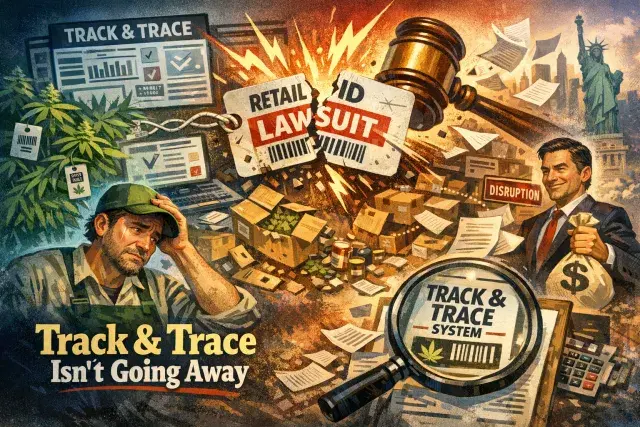

New York's legal cannabis market keeps expanding on paper, but a figure presented at the state's September 2026 Cannabis Advisory Board meeting tells a different story. Eighty-seven retailers reportedly owed 44 suppliers roughly $3.89 million in overdue payments, according to the New York Office of Cannabis Management. That's not a rounding error. That's cultivators, distributors and other licensed suppliers sitting on unpaid invoices while product keeps moving off their shelves and onto someone else's.
Why Wholesale Debt Builds Up So Fast
Cannabis retail runs on thin margins and a payment structure that doesn't resemble most other consumer goods. Dispensaries buy inventory from licensed distributors or directly from cultivators, often on net-30 or net-60 terms, then sell it to consumers under a state excise tax regime and, in many cases, without reliable access to traditional banking. Add 280E, the federal tax code provision that bars plant-touching businesses from deducting ordinary business expenses, and the cash available to pay suppliers on time shrinks fast. A retailer squeezed between tax bills, rent, payroll and compliance costs will often push supplier payments to the back of the line - not out of bad faith, necessarily, but because the math simply doesn't close.
The result is a kind of informal credit system baked into wholesale cannabis pricing. Suppliers extend terms because refusing to do so means losing shelf space entirely. That works fine until it doesn't - and $3.89 million across 44 suppliers suggests it's not working particularly well right now.
What This Means for Suppliers and Operators
For cultivators and distributors, unpaid receivables aren't an abstract line item. They're the difference between making payroll, restocking nutrients and packaging, or falling behind on their own compliance obligations. A cultivator carrying six figures in unpaid wholesale invoices has less room to invest in lab testing consistency, batch tracking accuracy, or the kind of operational discipline regulators expect under seed-to-sale systems like METRC.
For retailers, chronic late payment creates its own risk. Suppliers may start tightening terms, demanding payment on delivery, or simply declining to restock certain SKUs - which thins out wholesale menus and leaves budroom inventory less diverse. In a market where consumers already compare dispensary selection closely, that's a competitive disadvantage that compounds over time.
- Thin retail margins combined with 280E tax exposure limit cash available for supplier payments
- Extended wholesale credit terms function as informal financing across the supply chain
- Unpaid invoices can slow supplier investment in compliance, testing, and inventory consistency
- Persistent nonpayment risks reducing product diversity on dispensary shelves over time
A Market Health Question Regulators Can't Ignore
Licensing counts and sales figures make for easy growth narratives, but they don't capture whether money is actually circulating in a way that keeps the supply chain solvent. New York's Office of Cannabis Management tracks this kind of payment data precisely because license counts alone don't tell regulators whether the market is structurally sound.
The thing is, a market can post rising sales and still be fragile underneath. If suppliers can't collect what they're owed, some will scale back production, tighten credit further, or exit the legal market altogether - all of which ripples back to retailers in the form of thinner inventory and less price competition. Fair enough to celebrate growth. But growth without reliable payment flow is a market carrying debt it hasn't priced in yet.