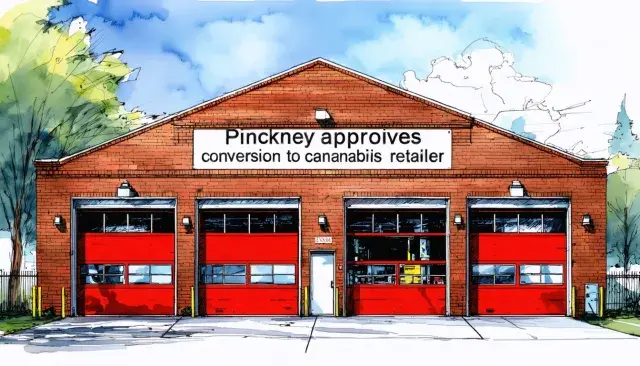
The Fire Station Cannabis Dispensary opened its fourth Upper Peninsula location in Hannahville, Michigan this week, situating itself directly adjacent to the Island Resort and Casino in Menominee County. The expansion marks a steady geographic push across the U.P. for an operation that claims the distinction of being the region's first recreational cannabis retailer - and signals that the rural Michigan cannabis market is far from saturated.
From Negaunee to Hannahville: A Regional Buildout
The company's growth has been deliberate and sequential. Negaunee came first, establishing the brand's foothold in the central U.P. Then Marquette, the region's most populous city. Houghton followed just weeks ago. Now Hannahville - a location that carries its own logic. Placing a dispensary next to a resort and casino isn't accidental; high-traffic hospitality destinations generate the kind of foot traffic that standalone retail rarely commands on its own in rural settings.
General Manager Marsha Moffett described the Hannahville opening as a rapid mobilization. "Really quickly just try to get all the product in and on the shelves," she said. That kind of hustle-to-open cadence is common in markets where operators move fast to secure position before competitors arrive - though in much of the U.P., low population density has kept the competitive pressure more measured than in southern Michigan metros.
What's on the Shelves
The product mix at Hannahville covers the full standard range of a modern dispensary: flower, pre-rolls, gummies, chocolate bars, brownies, tinctures, drink enhancers, vape cartridges, and concentrates. That breadth matters. Edibles, in particular, have become a dominant category in recreational cannabis retail - appealing to consumers who want the effects without combustion, and to older or first-time customers who find the dispensary experience less intimidating when the products resemble familiar formats like a chocolate bar or a gummy.
Curbside pickup is also available, a feature that became something close to table stakes for dispensaries during the pandemic and has largely remained so. In rural areas with older demographics or customers who simply prefer discretion, curbside access isn't a minor convenience - it removes a real barrier to entry.
Cannabis Retail in Rural Michigan: A Different Kind of Market
Michigan legalized recreational cannabis in 2018, and the state's dispensary buildout has - predictably - concentrated in population centers. The U.P. is different. Lower population density, longer distances between communities, and a workforce and customer base with different economic and cultural profiles mean that operators serving this region are making a different kind of bet than their counterparts in Grand Rapids or Detroit.
What's striking here is the community language The Fire Station is deploying alongside its retail expansion. Moffett frames the Hannahville opening not as a transaction but as relationship-building - "building meaningful relationships with a community," as she put it. That framing isn't purely rhetorical. In smaller communities, where a business's reputation travels fast and local trust is hard-won, how a dispensary presents itself to its neighbors carries real downstream effects on its long-term viability.
The proximity to tribal land - the Hannahville Indian Community is a federally recognized tribe - adds another layer of context worth acknowledging. Tribal nations across the country have navigated cannabis policy through a distinct legal and sovereign framework, and commercial dispensaries operating near or within tribal territories are part of a broader, still-evolving pattern of cannabis commerce intersecting with tribal economic development. The Island Resort and Casino is a tribal enterprise, and the decision to locate adjacent to it positions The Fire Station at the edge of that economic ecosystem, if not directly within it.
The Larger Trajectory
Four locations in the U.P. in relatively short succession suggests The Fire Station isn't finished. Moffett's language - "folks around the area or if you're just passing through" - hints at awareness that transient traffic, not just local regulars, will be part of the revenue mix at Hannahville. The U.P. draws seasonal tourism, outdoor recreation visitors, and cross-regional travelers in ways that many rural Michigan counties do not.
To put it plainly: this is a small-scale regional expansion story, but it sits inside a much larger one - the ongoing normalization of cannabis retail across geographies that, not long ago, wouldn't have hosted it at all. The Fire Station's Hannahville opening won't move statewide metrics, but for Menominee County, it's the arrival of an industry that is still, in many parts of rural America, a genuinely new presence.