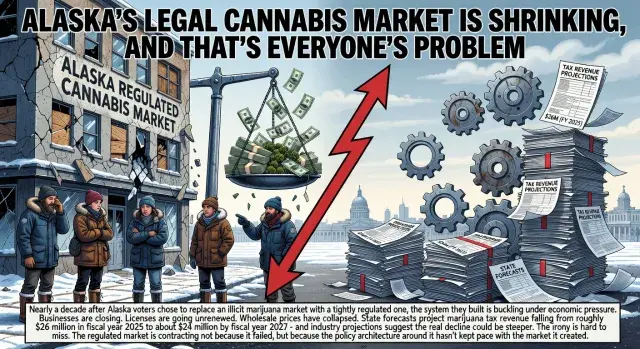
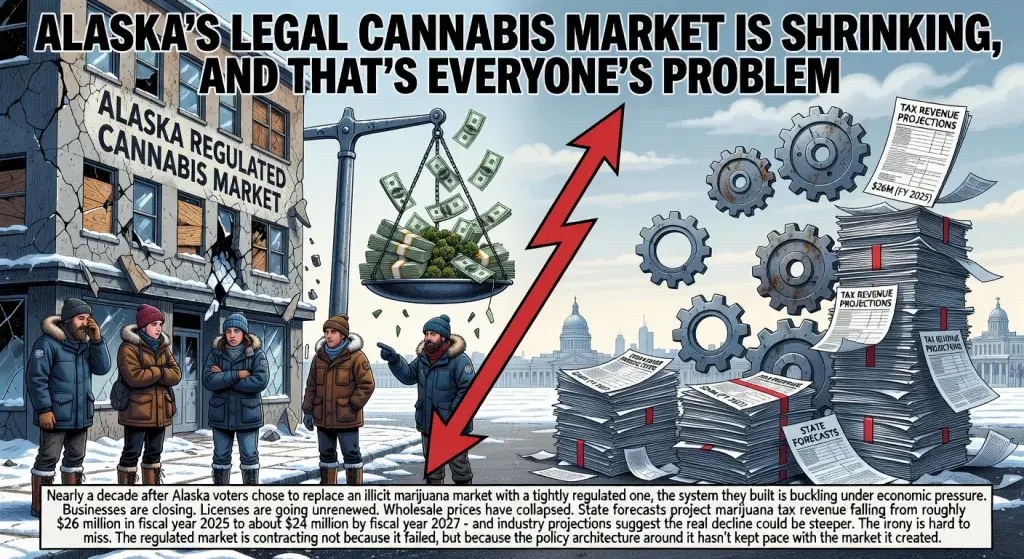
Nearly a decade after Alaska voters chose to replace an illicit marijuana market with a tightly regulated one, the system they built is buckling under economic pressure. Businesses are closing. Licenses are going unrenewed. Wholesale prices have collapsed. State forecasts project marijuana tax revenue falling from roughly $26 million in fiscal year 2025 to about $24 million by fiscal year 2027 - and industry projections suggest the real decline could be steeper.
The irony is hard to miss. The regulated market is contracting not because it failed, but because the policy architecture around it hasn't kept pace with the market it created.
A Tax Structure Frozen in Time
Alaska adopted a cultivation-based excise tax when legal cannabis prices were substantially higher than they are today. That made sense in the early years of legalization, when supply was limited and margins were wide. But as the market matured, wholesale prices fell - dramatically. The tax, however, did not adjust.
The downstream effect is straightforward. Licensed producers absorb a tax burden calibrated to a market that no longer exists. Much of that cost gets passed to consumers through higher retail prices, which in turn makes regulated products less competitive against unregulated alternatives. In practice, the tax structure is inadvertently subsidizing the illicit market it was designed to replace.
And here's the thing: a shrinking legal market doesn't mean fewer people are buying cannabis. It means more of that commerce is migrating back into unregulated channels - channels with no testing, no tracking, no age restrictions, and no tax revenue flowing to the state.
Licensing Fees That Exceed Their Own Justification
The financial squeeze doesn't stop at the tax code. A recent legislative audit of the Alcohol and Marijuana Control Office found that marijuana licensing fees generate more revenue than the program actually costs to administer. Licensed cannabis businesses, in other words, are paying more than the cost of their own regulation.
That's not a minor accounting discrepancy. It's a structural disincentive. When fees exceed the cost of oversight, they function as an additional tax - one that falls exclusively on operators who chose to do business within the legal framework. Every operator who surrenders a license or shuts down erodes the regulatory system's base. Fewer licensees means either higher per-business costs or reduced regulatory capacity. Neither outcome serves public interest.
The Hemp Loophole - Partially Closed, Still Leaking
Alaska moved faster than most states on intoxicating hemp-derived products. In 2023, state regulators prohibited chemically converted THC products, addressing a loophole in the 2018 Farm Bill that had allowed intoxicating hemp derivatives to be sold with virtually no oversight nationwide. Congress has since moved to close that federal gap as well.
Yet intoxicating hemp-derived products continue to circulate in Alaska's marketplace. They compete directly against licensed cannabis retailers who must comply with seed-to-sale tracking, laboratory testing, and age-verification requirements. The asymmetry is corrosive. Licensed businesses carry the full cost of compliance; their unregulated competitors carry none of it.
Federal reform may eventually bring clarity. But Alaska cannot afford to wait for Washington to stabilize a market that exists under state law and state authority.
What's Actually at Stake
This is not an abstract policy debate. Alaska's cannabis tax revenue supports education, substance abuse treatment programs, and the state's general fund - at a time when the state's broader fiscal outlook remains uncertain. A predictable revenue stream matters. Letting it erode by inaction is a choice, not an inevitability.
The tools to address these problems already exist at the state level. The legislature can modernize the tax structure to reflect current wholesale prices. It can align licensing fees with actual regulatory costs. It can strengthen enforcement against products that circumvent the regulated system. None of this requires expanding cannabis access or loosening consumer protections. It requires updating an economic framework that was built for 2016 and is now failing in 2025.
Alaska built one of the most structured cannabis regulatory systems in the country - locally owned, tightly tracked, laboratory tested. All of that architecture becomes meaningless if the businesses operating within it can't survive. Regulation only works when the regulated market does.