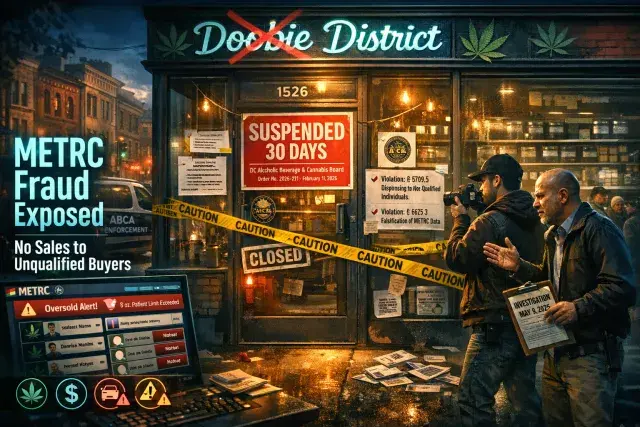
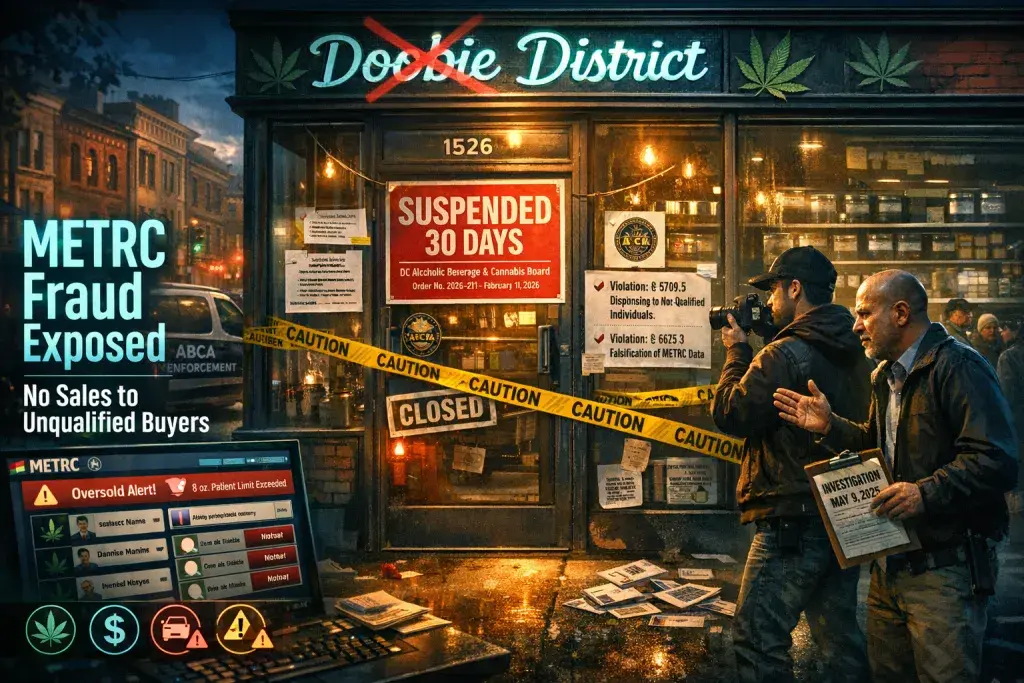
The District of Columbia Alcoholic Beverage and Cannabis Board has imposed a 30-day suspension on KLM, LLC, operating as Doobie District on U Street, for dispensing medical cannabis to unqualified buyers and falsifying records in the state's METRC tracking system. Issued February 11, 2026, in Order No. 2026-211, this action underscores the Board's commitment to safeguarding patient access and preventing diversion in DC's tightly regulated medical cannabis market.
Investigation Reveals Serious Compliance Failures
An ABCA probe launched May 9, 2025, followed tips about unauthorized sales at the 1526 U Street, NW location. Undercover agents made two controlled purchases of confirmed medical cannabis without showing patient cards or caregiver credentials. Labels on the products bore a Doobie District employee's name and ID, not the buyers'.
Further scrutiny exposed METRC manipulations: the employee's account showed purchases exceeding DC's 8-ounce, 30-day patient limit, with two other accounts similarly oversold using the same credentials. The Board upheld violations of:
- 22-C DCMR § 5709.5: Dispensing to non-qualified individuals.
- 22-C DCMR § 5615.3: Entering false data into METRC, DC's seed-to-sale system.
These lapses highlight vulnerabilities in frontline verification, a common pitfall in cannabis retail where high demand pressures staff to cut corners.
Dispensary's Mitigation Efforts Fall Short
Owner Peter Murillo stipulated to the facts but argued for leniency, citing an internal probe that led to firing implicated employees, staff retraining, and new oversight like weekly sales tracking. Despite this, the Board rejected revocation but stressed negligent supervision demands accountability.
The 30-day medical cannabis license suspension begins soon, plus mandatory ABCA-approved training within 60 days. Non-compliance risks reimposition. Such measures reflect evolving enforcement in DC, where medical cannabis sales hit over $100 million annually, per recent ABCA data, amplifying the stakes for public health.
Implications for Patient Safety and Market Integrity
Seed-to-sale systems like METRC are critical for traceability, curbing black-market diversion that fuels unregulated potency and contaminants. DC's strict 8-ounce limit protects against overconsumption risks, including dependency and impaired driving—issues plaguing nascent cannabis markets nationwide.
This case signals tighter scrutiny amid DC's medical program maturation since 2011, paralleling federal shifts toward rescheduling. For consumers, it reinforces verifying licensed status; for operators, it warns that remedial steps alone won't shield against penalties. Expect more audits as ABCA ramps up to ensure equitable, safe access in a $200 million-plus industry.