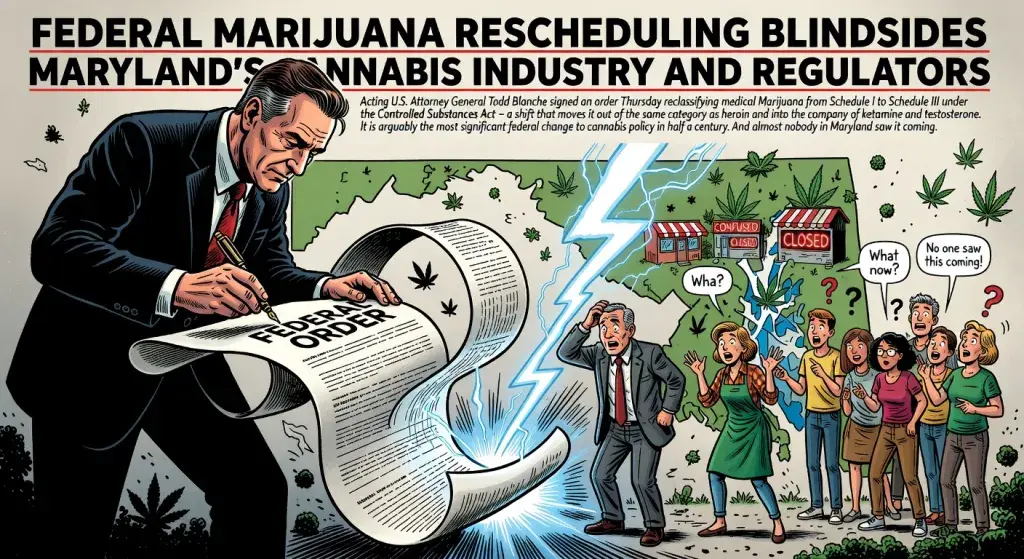
Acting U.S. Attorney General Todd Blanche signed an order Thursday reclassifying medical marijuana from Schedule I to Schedule III under the Controlled Substances Act - a shift that moves it out of the same category as heroin and into the company of ketamine and testosterone. It is arguably the most significant federal change to cannabis policy in half a century. And almost nobody in Maryland saw it coming.
A State Caught Off Guard
The reaction across Maryland was swift and, frankly, uniform: confusion. State regulators, dispensary owners, and budtenders all said the same thing - they don't fully understand the implications yet, and they're waiting for someone who does.
"We are still figuring out some of these answers ourselves as we speak with partners across other states and federally," said Maryland Cannabis Administration Director Tabatha Robinson on Thursday. The agency issued a statement affirming that Maryland law "remains fully operative and unchanged" and that it is reviewing the federal action with legal counsel. In calls to cannabis shops across the state, employees echoed the refrain: business as usual, for now.
Here's the catch. Maryland isn't just a medical marijuana state. It's one of 24 states - plus the District of Columbia - that have also legalized recreational adult-use cannabis. Blanche's order applies only to medical marijuana. That distinction creates a tangled jurisdictional question: how do you separate the medical from the recreational in a state where the same dispensaries, under hybrid licenses, sell both?
Maryland's cannabis system evolved organically. The medical program launched in earnest in 2014, though the first actual sales didn't occur until December 2017. When the state later legalized recreational use, it grafted the new market onto the existing infrastructure - same growers, same manufacturers, same dispensaries. Medical cardholders got a tax exemption; everyone else paid the standard retail levy. The two streams flow through the same pipes. Separating them for federal compliance purposes is not straightforward.
The Tax Relief That Actually Matters
For all the ambiguity, one benefit is concrete and immediate: taxes. Under Section 280E of the Internal Revenue Code, businesses trafficking in Schedule I or II controlled substances cannot deduct ordinary business expenses on their federal returns. That provision has been a financial millstone around the neck of every state-legal cannabis operation in the country.
"The industry has suffered underneath that provision, especially dispensaries, because they can write almost nothing off," said Jake Van Wingerden, owner of Cecil County-based SunMed Growers. His tax filings, he explained, are a "big, complicated mess" - one set calculated on state profits, another on federal gross sales. Maryland's General Assembly had already fixed the deduction issue at the state level, but the federal burden remained.
Rescheduling to Schedule III eliminates that penalty for medical cannabis. Businesses would be taxed on actual profits, like every other company in the country. That sounds tidy on paper, but the question of how recreational sales fit into this framework - or whether they do at all - remains unanswered.
New Federal Entanglements
Buried in the order is a provision that could reshape distribution itself. It appears to require manufacturers to sell their product to the federal government at a nominal price, with the government then reselling to "registered purchasers" at the same rate. Manufacturers would also owe an "administrative fee" for these transactions. In effect, the federal government would insert itself as a middleman - a structure that could serve as the scaffolding for a future federal cannabis tax or surcharge.
That is a significant expansion of federal involvement in a market that has, until now, existed in a gray zone between state legality and federal prohibition. Whether this mechanism is workable - or even enforceable - remains to be seen.
Research access, another stated goal of the rescheduling, may prove less transformative than advertised. Schedule III drugs still face stringent regulatory requirements for clinical study. The barriers drop, but they don't disappear.
What Comes Next
Van Wingerden, despite the chaos, called the order "the next step in legitimacy for the industry." He's not wrong. Federal rescheduling could create downstream momentum for banking reform - a persistent and practical headache. Many financial institutions still refuse to serve cannabis businesses, wary of federal exposure. A formal reclassification could soften that reluctance, though it won't eliminate it overnight.
For Maryland specifically, the weeks ahead will be about translating a federal order into operational reality - or determining that, in some respects, it simply doesn't translate. The Cannabis Administration has promised further guidance. Dispensaries are keeping their doors open. And the most honest answer anyone in the state's cannabis industry can give right now is also the most unsatisfying one: we don't know yet.