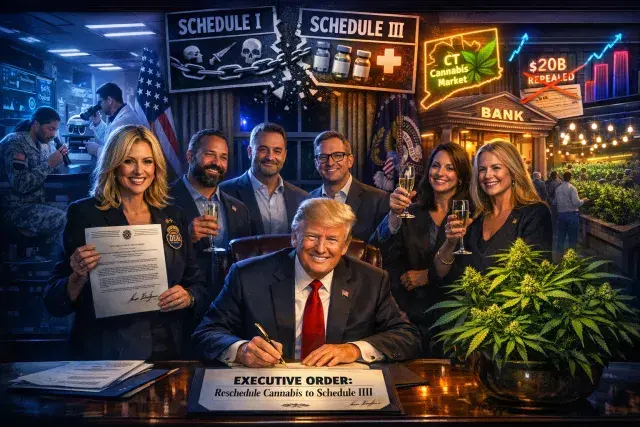
President Trump signed an executive order on Thursday directing the U.S. Drug Enforcement Administration to reclassify cannabis from Schedule I—a category for highly addictive drugs with no medical use—to Schedule III, acknowledging its lower addiction potential and accepted medical benefits. This long-overdue shift promises easier research funding, tax relief for businesses, and better access for patients, particularly in states like Connecticut where medical and recreational markets thrive.
Understanding the Schedule Shift
Cannabis has languished in Schedule I since 1970, alongside heroin and LSD, stifling scientific inquiry despite growing evidence of its role in managing chronic pain, nausea, and PTSD. Schedule III placement aligns it with drugs like ketamine, easing federal restrictions while maintaining oversight.
- Eliminates major barriers to public research funding, previously nearly impossible under Schedule I.
- Focuses on medical applications, citing relief for chronic pain and other ailments as stated in the order.
- Connecticut operators like Ben Zachs of Fine Fettle call it "much deserved," predicting immense research gains without daily operational changes.
Boosting Medical Research and Veteran Care
The endocannabinoid system, a key regulator of pain, mood, and inflammation discovered decades ago, has been underexplored due to federal hurdles. Reclassification unlocks rigorous studies, vital for veterans seeking alternatives to opioids.
Erin Gorman Kirk, Connecticut's cannabis ombudsman, highlights how DEA bottlenecks have stalled progress: "They're killing the research." Rino Ferrarese of Affinity Cannabis agrees, noting it aligns policy with science for therapeutic advancements. Early data shows cannabis reduces opioid use by up to 64% in some chronic pain cohorts, a trend this move could quantify nationwide.
Economic Relief for Cannabis Businesses
A major win is ending Section 280E tax code restrictions, which barred deductions for business expenses, crippling profitability. In Connecticut, this frees capital for expansion and lower prices.
- Zachs anticipates smarter investments and consumer pricing.
- Adam Wood of the Connecticut Cannabis Chamber of Commerce praises it as "transformative" for economic justice.
- Kim Rivers of Trulieve, present at the signing, eyes banking reforms next to enable stock listings on major exchanges.
Broader Implications and Next Steps
While recreational federal legalization remains distant, this fosters state-federal harmony, reducing risks for the $30 billion U.S. cannabis industry. Public health benefits could accelerate as research reveals cannabis's full potential in mental health and beyond, signaling a cultural pivot from prohibition to pragmatic medicine. Expect congressional action on banking soon, building momentum for sustained reform.