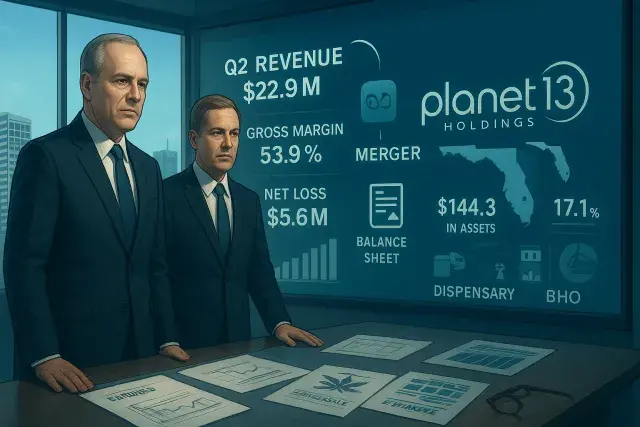
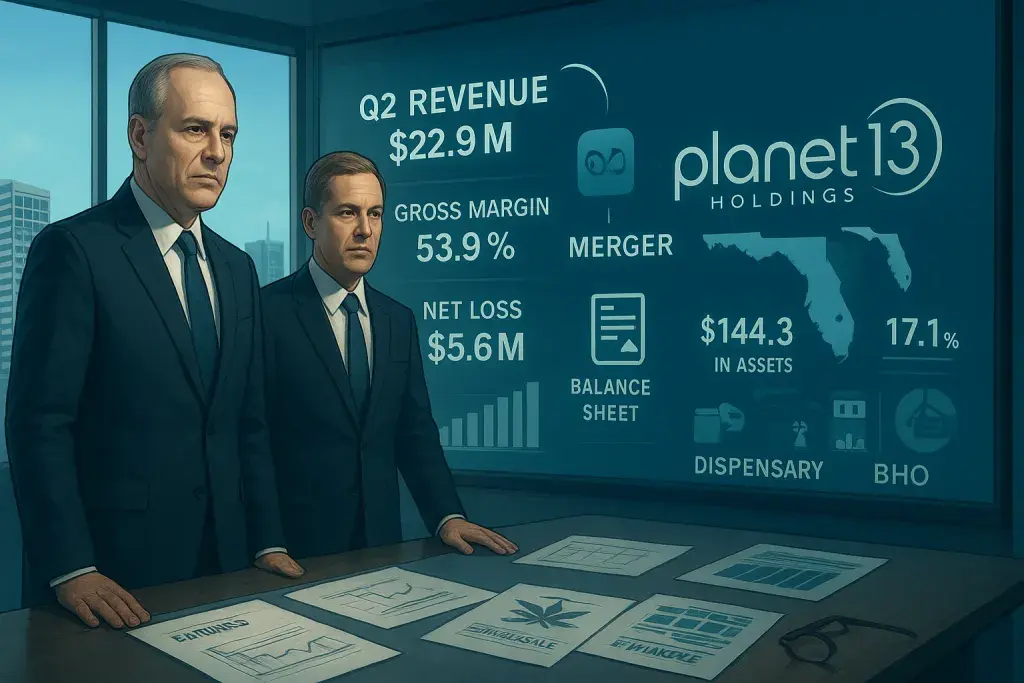
Planet 13 Holdings reported second-quarter revenue of $22.9 million, down 14.9% from a year earlier, as the multi-state operator absorbed the effects of exiting California retail and wholesale and continued price compression in Nevada and Florida. The Las Vegas-based company also posted a narrower net loss and a smaller Adjusted EBITDA deficit, evidence that cost discipline is starting to show up on the bottom line even as top-line sales shrink. The results arrive as Planet 13 works toward closing its previously announced merger with Vireo Growth, a deal that reshapes how investors should read this quarter's numbers.
Margin Gains Tell a Different Story Than Revenue
Here's the catch with reading this release at face value: revenue fell nearly 15%, yet gross margin actually improved to 53.9% from 43.4% a year earlier. That's not a contradiction - it's what happens when a company sheds a lower-margin, capital-intensive market like California and tightens procurement everywhere else. Planet 13 also noted that a $1.0 million reduction in its Florida distillate inventory reserve flattered the margin line; strip that out, and gross margin still lands at a respectable 49.5%. For operators watching their own numbers, this is a useful reminder that inventory reserve adjustments can swing reported margin meaningfully in a single quarter, and it's worth asking any comparable company to break out the one-time items rather than take the headline figure at face value.
Total expenses dropped 17.7% year-over-year, a sign that the cost-cutting initiatives management referenced weren't just talk. Net loss narrowed to $5.6 million from $13.3 million, and Adjusted EBITDA loss shrank to $0.5 million from $2.4 million. In an industry still grinding under 280E tax treatment and compressed wholesale pricing, that kind of expense discipline is often the difference between a company that survives to consolidate and one that gets consolidated.
Florida Momentum Matters More Than It Looks
Florida revenue rose 17.1% quarter over quarter, and Co-CEO Larry Scheffler pointed to that figure as proof the state business is stabilizing. Florida has been a tricky market for multi-state operators - regulatory approval cycles for extraction and processing facilities move slowly, and building out a dispensary footprint there requires patience most public companies don't love advertising. Planet 13's OMMU approval for a BHO extraction facility in May and its plan for an upcoming Sarasota store both point to a company still investing in Florida even as it retreats from California. That's a meaningful signal for wholesale partners and landlords evaluating where an operator's long-term commitments actually sit.
The Merger Overhang
None of this quarter's operational progress can be separated from the pending Vireo Growth merger, announced July 27. Co-CEO Bob Groesbeck was direct about the rationale: the market increasingly rewards scale, purchasing power, and balance-sheet strength to absorb continued price compression, and a combined company gives Planet 13 shareholders exposure to that scale rather than going it alone. Planet 13 also skipped its usual earnings conference call this quarter specifically because of the pending deal, a common practice when management wants to avoid saying anything that could complicate a transaction moving through regulatory and shareholder review.
For dispensary operators and suppliers watching the multi-state landscape, this deal is a data point in a broader pattern: standalone regional operators facing thin margins and heavy compliance costs are increasingly looking to combine rather than compete indefinitely. Vertical integration alone - cultivation, extraction, retail all under one roof - no longer guarantees profitability when wholesale pricing keeps sliding. Scale, distribution reach, and balance-sheet depth are becoming the metrics that matter most, and that shift has implications for wholesalers negotiating supply agreements and landlords underwriting dispensary leases in competitive adult-use and medical markets alike.
Balance Sheet Still Carries Weight
Total assets fell to $144.3 million from $152.3 million since year-end, while total liabilities rose to $105.5 million from $101.2 million. Cash and restricted cash held roughly steady at $16.5 million. Those are not alarming figures on their own, but they underscore why the merger timeline matters: a smaller, leaner Planet 13 needs the deal to close cleanly to realize the balance-sheet benefits Groesbeck described. Investors, employees, and patients across Nevada, Illinois, and Florida are effectively waiting on regulatory and closing mechanics rather than quarterly operating trends to determine what comes next.