A one-month reprieve on federal hemp restrictions survived a Senate floor fight last week, but the underlying policy fight is far from settled. Sen. Ted Budd, R-NC, tried and failed to strip a 30-day delay out of the Senate's continuing resolution, a move that would have let sweeping new limits on intoxicating hemp products take effect Nov. 12 as originally scheduled instead of Dec. 11. The vote - 61-32 to table Budd's amendment - crossed party lines and exposed just how unresolved this issue remains for anyone selling hemp-derived cannabinoid products at retail.
For operators running convenience stores, smoke shops, or multi-state cannabis retail chains that also carry hemp-derived THC beverages and gummies, this is not an abstract Washington squabble. It's a compliance deadline that keeps moving, which makes inventory planning genuinely difficult. Retailers in states with parallel state-level THC caps, or those watching adjacent markets for regulatory cues, are having to build contingency plans around a moving target rather than a fixed rule. Point-of-sale infrastructure matters here too - platforms built to handle SKU-level cannabinoid tracking and compliant labeling, the kind offered through a Texas cannabis POS system, illustrate how retail technology vendors are already adapting to a regulatory environment where THC thresholds, not just plant type, determine what can legally sit on a shelf.
What the Federal Hemp Rule Actually Changes
The underlying law, approved by Congress in November 2025, redefines hemp based on total THC content rather than delta-9 THC alone, and it excludes finished hemp-derived products containing more than 0.4 milligrams of combined total THC and similar cannabinoids per container. That is a dramatically tighter standard than the 0.3% dry-weight threshold that has governed hemp since the 2018 Farm Bill, and it would functionally remove most THC beverages, delta-8 vapes, THCA flower, and infused gummies from convenience-store and gas-station shelves nationwide. Budd's argument, delivered on the Senate floor, framed this as a public-safety necessity rather than a technical rule change - he pointed to packaging that mimics popular snack and candy brands as evidence the market has targeted younger consumers, whether intentionally or not.
A Coalition Divided Over Timing, Not Just Substance
What's striking here is that almost nobody in this fight is defending the unregulated status quo outright. The 105 organizations that opposed Budd's amendment - including the US Hemp Roundtable, the National Association of Convenience Stores, and several North Carolina hemp trade groups - argued for the 30-day delay specifically so Congress could pass stronger rules: good manufacturing practices, import restrictions on synthetic cannabinoids from China, and stricter child-resistant packaging. In other words, the fight isn't really about whether to regulate. It's about whether regulation happens through an outright THC cap or through a more calibrated licensing and testing framework, the kind familiar to state-regulated cannabis markets that already require lab testing, COA verification, and compliant packaging before product reaches a dispensary shelf.
North Carolina's Parallel Deadlock
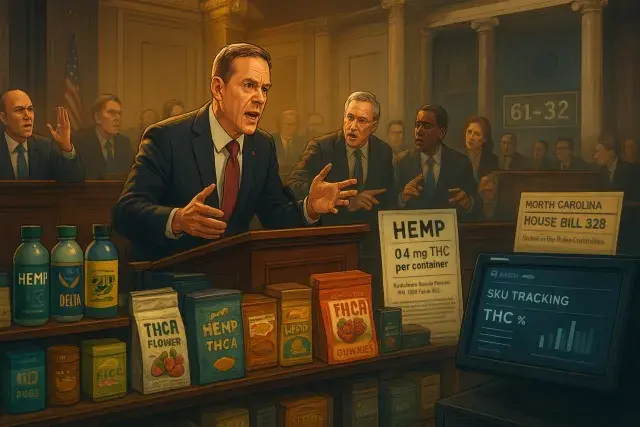
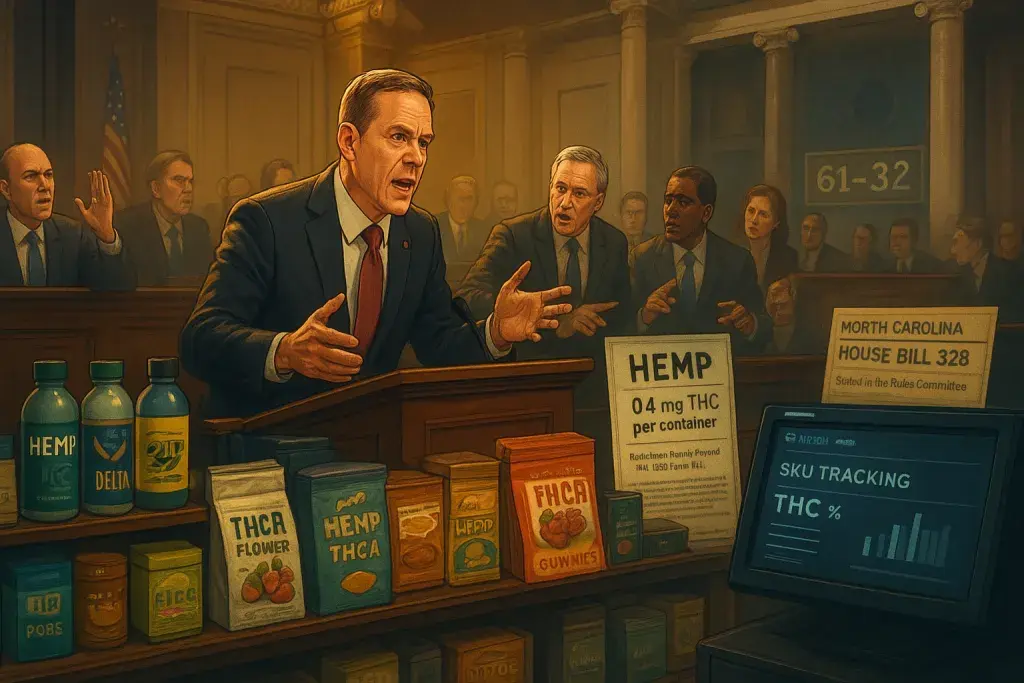
The federal fight has a direct mirror in Raleigh, where House Bill 328 would write the same 0.4-milligram total THC limit into North Carolina law, independent of what Congress ultimately does. The state Senate passed the conference report 37-6 back in July, but the House has repeatedly declined to act, leaving the bill parked in the Rules Committee. That matters for operators because it means North Carolina's restriction could take effect even if federal lawmakers delay, rewrite, or abandon their own version - state and federal timelines are no longer guaranteed to move together, which is exactly the kind of compliance fragmentation that makes multi-state retail planning harder.
- Federal restrictions are currently set to take effect Dec. 11, 2026, under the continuing resolution's delay provision.
- North Carolina's HB 328 would impose the same 0.4 mg total THC cap directly into state law, regardless of federal action.
- Age restrictions in HB 328 would bar sales to anyone under 21 and criminalize underage possession.
- Industry coalitions want the extra time used for GMP standards, import controls, and packaging rules rather than a blanket ban.
None of this resolves the core tension retailers are facing: a THC threshold approach eliminates ambiguity but also eliminates most of the current product catalog, while a regulatory framework preserves market access but requires the kind of testing, labeling, and age-verification infrastructure many hemp retailers have never had to build. Speaker Destin Hall's plan to convene a smaller working group before year's end suggests North Carolina lawmakers know they need a answer - they just haven't agreed on which one.